Affiliate links: as an Amazon Associate and through other programs, we earn from qualifying purchases, at no extra cost to you. Learn more.
In This Article
Short answer: for most homes, start with the Vellgus Elite V2: 60 LEDs in six wavelengths from 480 to 850 nm, $549 on sale (regular $649) on vellgus.com on October 8, 2026. Choose the Vellgus Pro for larger areas, the Max 300 for whole-body sessions and the Mini for one spot at a time.
We earn a commission on purchases through our Vellgus and Amazon links, at no extra cost to you. We have not lab-tested these panels: specs, prices and policies come from vellgus.com (checked October 8, 2026) and the evidence from the linked studies. For masks and handhelds, see our red light therapy devices guide.
Get our Supplement Dosing Guide — free.
The exact dosages from published research, compiled into one reference PDF. No fluff, no upsell.
🔒 No spam. Unsubscribe anytime. We send 1-2 emails/month max.
Which red light panel to buy
| Your goal | Panel | Price on vellgus.com (Oct 8, 2026) | Why |
|---|---|---|---|
| Face, neck or one area at a time | Vellgus Elite V2 | $549 (regular $649) | Table stand and door hook included; 3-year warranty |
| Muscle recovery on larger areas | Vellgus Pro | $849–1,119 | Twice the LEDs of the Elite V2, no blue channel |
| Whole body | Vellgus Max 300 | $1,100–1,399 | 92 cm long, enough for the torso or both legs at once |
| A sore knee, travel or a tight budget | Vellgus Mini | $339 | Small and battery powered; 1-year warranty |
💡 Prices are approximate and were last reviewed in October 2026. Retailer prices change often — tap a button for the current price on Amazon or iHerb.
If facial skin is your only goal, a mask may suit you better than any panel: see red light panel vs mask. Not sure which device type you need? The red light device finder asks three questions.
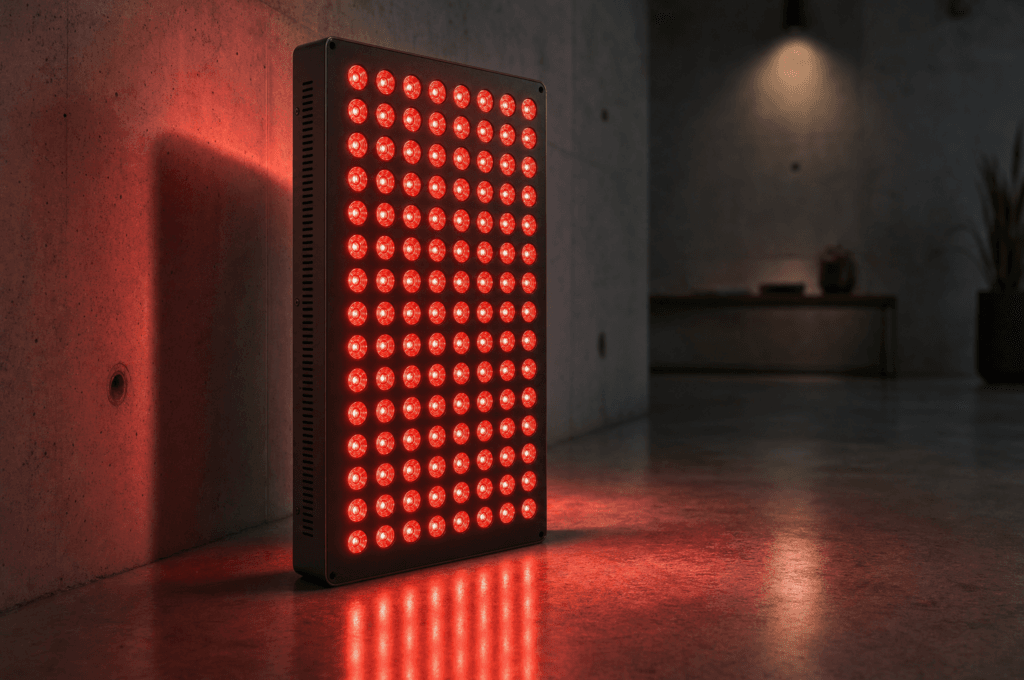
Vellgus panels compared
| Panel | Size | LEDs | Wavelengths (nm) | Price (Oct 8, 2026) | Warranty |
|---|---|---|---|---|---|
| Mini | 15 × 9.5 cm (5.9 × 3.7 in) | 15 × 5 W | 660, 850 | $339 (pre-order) | 1 year |
| Elite V2 | 26 × 20 cm (10.2 × 7.9 in) | 60 × 5 W | 480, 630, 660, 810, 830, 850 | $549 (regular $649) | 3 years |
| Pro | 52 × 21 cm (20 × 8.2 in) | 120 × 5 W | 630, 660, 810, 830, 850 | $849 door hook, $949 floor stand, $1,119 flex mobile stand | 3 years |
| Max 300 | 92 × 30 cm (36.2 × 11.8 in) | 300 | 630, 660, 810, 830, 850 | $1,100 door hook (regular $1,299), $1,300 floor stand, $1,399 flex mobile stand (regular $1,499) | 3 years |
The Pro V2 ($899–1,199) was listed as sold out on October 8, 2026. Prices change often, so check the product page before you buy.
The Vellgus panels, model by model
Vellgus Elite V2: best for most people
Six wavelengths, 2.6 kg, a built-in table stand plus a door hook, goggles, a remote, and dimming and pulse modes. Vellgus calls it a half-body panel, but at 26 × 20 cm expect to treat one area at a time: your face, a shoulder or a knee. It is on sale, and sale items are final for elective returns.
Check the Elite V2 price at Vellgus
Vellgus Pro: more coverage for recovery
Twice the LEDs and twice the length of the Elite V2 (4 kg), with no blue channel, so it suits a thigh or the lower back. A door hook, goggles and a remote are included; the stand versions cost more. The door-hook version was not discounted on October 8, 2026, so it can be returned within 30 days, minus a 20% restocking fee and return shipping.
See the Pro on the Vellgus panel page
Vellgus Max 300: whole-body sessions
The largest Vellgus panel: 300 LEDs on 92 × 30 cm, 13.5 kg, with eight cooling fans. It is long enough to light your torso or both legs at once. That saves time, but it does not raise the dose on each area (see the studies below). Both discounted versions are final sale.
Check the Max 300 price at Vellgus
Vellgus Mini: one spot or travel
A 0.55 kg battery panel with a 10-minute timer and a 10-minute cool-down after each session, for a knee, an elbow or a patch of skin. Red and near-infrared cannot be switched on separately, goggles are not listed in the box, and it was on pre-order on October 8, 2026.
Check the Mini price at Vellgus
How to choose a red light panel
Wavelengths: 660 and 850 nm
Most trials used red light around 630–660 nm and near-infrared around 810–850 nm, such as 633 and 830 nm for wrinkles (Lee et al., 2007) and 655–950 nm for muscle performance (Vanin et al., 2018). Near-infrared reaches deeper; in a computer model of skin, penetration rose with wavelength (Ash et al., 2017). Extra wavelengths are not proven to help: in a 136-person trial, a broad 570–850 nm spectrum did no better than red light alone (Wunsch and Matuschka, 2014).
Irradiance and distance
Irradiance is the light power reaching your skin, in mW/cm². Multiplied by time it gives the dose: 50 mW/cm² for 10 minutes is 30 J/cm². It falls as you step back, so a figure without a distance tells you little. Vellgus lists more than 245 mW/cm² (more than 219 for the Mini) without saying at what distance; ask for a chart at 6, 12 and 18 inches. Vellgus suggests starting at about 2 minutes per area. More is not automatically better: lab and animal studies show a biphasic dose response (Huang et al., 2011), and when researchers measured five LED devices sold for home use, the makers’ instructions did not deliver an accurate dose (Cronshaw et al., 2025). Our red light dosing calculator suggests a starting routine by goal.
Size and coverage
A bigger panel covers more skin per session; it does not make the dose on each area stronger. A 2025 review of whole-body light (five studies, 105 active people) found no gain in performance or fatigue markers, although two studies reported better sleep (Álvarez-Martínez and Borden, 2025). Buy the size that covers the area you actually want to treat.
EMF and flicker
Vellgus lists an EMF reading of 0.00 at 4 inches for its panels and describes the Mini as flicker-free; the Elite V2, Pro and Max 300 also have a pulse mode. Treat these claims as build-quality points and ask how they were measured.
FDA-registered vs FDA-cleared
“FDA-registered” means the factory is registered with the FDA and the device is listed; federal rules say registration “does not in any way denote approval” (21 CFR 807.39). “FDA-cleared” means the FDA reviewed a 510(k) submission and found the device substantially equivalent to one already legally sold (FDA), for set uses such as wrinkle reduction, pain therapy or hair growth. Infrared lamps for topical heating are Class II but exempt from 510(k) review (21 CFR 890.5500), which is one way a panel can be an “FDA-listed Class II device” without any clearance. Vellgus calls its panels FDA-registered Class II devices; the FDA’s openFDA database showed no 510(k) clearance under the Vellgus name on October 8, 2026. Its ETL mark shows independent testing to electrical safety standards (Intertek), not that the light works.
Warranty and returns
Vellgus covers its panels for 3 years and the Mini for 1 year, for the original buyer, case by case. You can ask for a return within 30 days of purchase, but you must email first, you pay return shipping, a 20% restocking fee applies, and items bought on sale, and stands, are final (Vellgus warranty and return policy, read October 8, 2026). Shipping to the US and Canada is free.
Amazon alternatives
Amazon lists red light panels from many makers. Use the same checklist there: 660 and 850 nm stated, an irradiance chart with distances, a warranty you can actually claim, a return window you are happy with, and “FDA-cleared” rather than only “FDA-registered” if a claim matters to you.
What the studies say
Skin and wrinkles
In a split-face trial of 76 people, 633 nm, 830 nm or both, twice a week for 4 weeks, cut measured wrinkles by up to 36% and raised skin elasticity by up to 19% from baseline (Lee et al., 2007). A controlled trial of 136 volunteers found smoother skin and denser collagen on ultrasound after 30 sessions (Wunsch and Matuschka, 2014). The caveat: of 27 LED skin studies, none validated its dose, doses varied over three orders of magnitude and 10 were sponsored by the device maker (Grimes, 2025).
Muscle recovery
Pooled trials of lasers and LEDs, mostly applied to the muscle before exercise, found small gains, such as about 5.5 more repetitions than placebo (Leal-Junior et al., 2015); a review of 39 trials rated the evidence very low to moderate quality (Vanin et al., 2018). Whole-body light has not shown the same: in a crossover trial of 48 active adults, 20 minutes before all-out cycling sprints did not improve power output, although next-morning heart rate variability was higher (Forsey et al., 2023).
Pain
The best pain data come from lasers placed on the sore spot. Low-level laser cut neck pain by about 20 mm on a 100 mm scale in the 11 trials that measured it, within a Lancet meta-analysis of 16 trials (Chow et al., 2009), and 22 knee osteoarthritis trials (1,063 people) showed less pain and disability at set doses of 785–860 nm or 904 nm per point (Stausholm et al., 2019). A fixed dose per point is hard to match with a panel at 6–12 inches, so these results may not transfer directly.
Hair
A 655 nm laser-and-LED helmet used every other day for 16 weeks raised hair counts 39 percentage points more than a sham device in men (Lanzafame et al., 2013) and 37 points more in women (Lanzafame et al., 2014); a review found more hair in 9 of 11 studies (Afifi et al., 2017). These were scalp devices, so the results apply to caps, helmets and combs, not wall panels.
Safety: eyes, skin, medicines and pregnancy
- Eyes. Wear the supplied goggles (and your own dark safety glasses with the Mini), and do not stare into the LEDs; near-infrared at 850 nm is barely visible, so a panel is stronger than it looks. Retinal damage has been reported in a 12-year-old with myopia after repeated low-level red-light laser exposure (Liu et al., 2023): a laser, not a panel, but a reason to protect your eyes.
- Dark spots and blue light. 415 nm blue-violet light darkened skin types III and IV while 630 nm red did not (Duteil et al., 2014), and visible light caused darker, longer-lasting pigmentation than UVA1 in skin types IV to VI (Mahmoud et al., 2010). With melasma or skin prone to dark spots, ask Vellgus whether the Elite V2’s 480 nm channel can be switched off, or choose the Pro, which has none.
- Photosensitizing medicines. The FDA lists medicines that make skin react to ultraviolet light, including some antibiotics (doxycycline, tetracycline), retinoids (isotretinoin), diuretics and NSAIDs (FDA). Panels emit no ultraviolet, but Vellgus itself tells users of photosensitizing drugs to get medical advice first, and that is the sensible default.
- Epilepsy. If you have photosensitive epilepsy, avoid pulse modes: flashing light at 15–25 Hz is the most likely to trigger seizures, and red flashes are a known factor (Fisher et al., 2005).
- Pregnancy. We found no trials of red light panels in pregnancy, so check with your doctor or midwife first.
- Moles and skin cancer. A 2023 systematic review found no clinical data linking cosmetic red and near-infrared light with new or recurrent cancer (Glass, 2023). Still, show a changing mole to a dermatologist instead of treating it.
This page is general information, not medical advice.
Frequently asked questions
How far should you stand from a red light panel?
About 6–12 inches from bare skin for around 10 minutes per area, 3–5 times a week, is the usual starting point and matches Vellgus’s guidance. Further back, add time: Vellgus suggests 15 minutes at 12–18 inches and 20 minutes at 18–24 inches.
Is an FDA-registered red light panel FDA-approved?
No. Registration only lists the maker and the device with the FDA; it is not a review of results. Clearance through a 510(k) is a separate step tied to specific uses, so look for a 510(k) number if a claim matters to you.
How long does red light therapy take to work?
Weeks, not days: the wrinkle trials ran from 8 to 30 sessions and the hair trials lasted 16 weeks. Take photos in the same light every few weeks to judge the results fairly.


The recovery gear guides
Compare cold plunge, sauna and red light, reviewed by our team.
- → Best Cold Plunge Tubs 2026
- → Best Cold Plunge Chillers 2026
- → Cold + Sauna Contrast Protocol
- → Best Cold Plunge Cost Guide
- → Best Cold Plunge Under $500
- → Best Infrared Saunas 2026
- → Sauna Blanket vs Sauna
- → Best Sauna Blankets 2026
- → Best Red Light Therapy Devices
- → Red Light Panel vs Mask
- → 7 Cold Plunge Benefits (Science)
- → Sauna Benefits for Longevity
- → Red Light Therapy Benefits
- → Cold Plunge Protocol Tool
- → Sauna Routine Calculator
- → Red Light Dosing Calculator