Affiliate links: as an Amazon Associate and through other programs, we earn from qualifying purchases, at no extra cost to you. Learn more.
In This Article
- Our picks
- All the lamps compared
- Why “10,000 lux” means little without a distance
- What the research shows
- How to use a light therapy lamp
- Side effects, and who should ask a doctor first
- The lamps in detail
- Products we looked at but didn’t pick (and why)
- How we chose
- FAQ
- Related guides
- What changed in this update
- Sources
Short answer: Buy a lamp that tells you the distance at which it reaches 10,000 lux, then sit at that distance for about 30 minutes soon after you wake up: the Carex Day-Light Classic Plus is rated for 10,000 lux at 12–14 inches (an independent clinic at Yale measured 10,000 lux at 13 inches), while many small lamps only reach 10,000 lux 6 inches from your face. Seasonal affective disorder is a medical condition, so use light therapy under medical guidance and talk to your doctor first, especially if you have depression, bipolar disorder (risk of triggering mania), eye conditions, or take photosensitizing medication.
If your low mood is severe, or you have thoughts of harming yourself, don’t wait for a lamp to work: contact a doctor now, or call or text 988 (Suicide & Crisis Lifeline, US).
NordVital earns a commission if you buy through some links on this page, at no extra cost to you. As an Amazon Associate we earn from qualifying purchases. We did not use or measure these lamps ourselves: specs come from each maker’s website or user manual (checked October 13, 2026), the independent measurements from the Yale School of Medicine’s Winter Depression Research Clinic, and the evidence from the studies linked below. This guide is general information, not medical advice.
Our picks
Best overall: Carex Day-Light Classic Plus
Why: Carex rates it for 10,000 lux at 12–14 inches, and the Yale clinic measured 10,000 lux at 13 inches, so the claim holds at a distance where you can read or eat breakfast.
See the Day-Light Classic Plus on Amazon
Best for a smaller desk: Carex Day-Light Sky
Why: It is a desk-lamp design with a screen of about 13 × 10 inches, and the Yale clinic still measured 11,000 lux at 12 inches.
See the Day-Light Sky on Amazon
Best for sitting farther back: Alaska Northern Lights NorthStar 10,000
Why: It is rated for 10,000 lux at 24 inches from a light area of 21½ × 11 inches, and the Yale clinic reports that this figure was close to its own measurement.
It is sold direct by the maker and did not show up in an Amazon search on October 13, 2026. See the NorthStar 10,000 on the maker’s site (not an affiliate link).
All the lamps compared
Lux is the amount of light that reaches your eyes, and it drops as you move back. That is why the distance column matters more than the “10,000 lux” printed on the box.
| Lamp | 10,000 lux at (maker) | Independent measurement | Light area | UV | Color temperature | Timer and settings | Price tier* | Where |
|---|---|---|---|---|---|---|---|---|
| Carex Day-Light Classic Plus | 12–14 in | 10,000 lux at 13 in (Yale) | 16 × 13 in | UV-free LEDs | 4,000 K | No timer; 2 levels (10,000 and 5,000 lux) | $$$ | Amazon |
| Carex Day-Light Sky | 12 in (manual); 12–14 in (product page) | 11,000 lux at 12 in (Yale) | 13.7 × 10.4 in (lamp head) | UV-free LEDs | 4,000 K | No timer; 2 levels (10,000 and 5,000 lux) | $$ | Amazon |
| Alaska Northern Lights NorthStar 10,000 | 24 in | Close to 10,000 lux at 24 in (Yale) | 21½ × 11 in | UV-free bulbs | 4,100 K | No timer; on/off | $$$$ | Maker |
| Circadian Optics Langham (Clinical) | 12 in (Standard); 18 in (Max) | None found | 6 × 17 in (Standard); 12 × 22 in (Max) | UV-free LEDs | 5,500 K | No timer listed; dimmer knob | $$ (Standard); $$$ (Max) | Amazon |
| Northern Light Technologies BOXelite | Up to 14 in (product page); 15–17 in (instruction sheet) | 7,000 lux at about 16 in (Yale) | 15 × 12 in | UV filter; “no UV” per maker | “Cool white” (Kelvin not stated) | No timer; on/off | $$$ | Amazon |
| Verilux HappyLight Luxe | 6 in | None found | 11.7 × 7.5 in (whole lamp) | UV-free LEDs | 3,500, 4,250 or 5,000 K | Timer up to 60 min (5-min steps); 4 levels (2,500–10,000 lux) | $$ | Amazon |
*Approximate price tiers, based on list prices on the makers’ own websites on October 13, 2026: $ = under $50, $$ = $50–$150, $$$ = $150–$300, $$$$ = over $300. Retailer prices, including Amazon’s, change often and can be higher or lower. Specs are the makers’ claims unless marked “Yale”.
Why “10,000 lux” means little without a distance
Every lamp is brightest right at its surface, so a small lamp can truthfully say “10,000 lux” while giving you much less from where you actually sit. Three facts to keep in mind:
- In a 2019 study, 12 makers lent or donated 24 light therapy devices to researchers. Only 7 larger light boxes met all three clinical criteria (enough light at a reasonable distance, over a reasonable area, without uncomfortable glare). Some devices sold as “10,000-lux” reached that level only at unreasonably close distances, over a small area, or with glare (Psychiatric Research and Clinical Practice, 2019).
- The Yale clinic’s criteria for a suitable box: at least 7,500 lux at about 11 inches, still at least 5,000 lux if you move your head 5 inches in any direction, and no glare or hot spots. It adds that many experts consider 30 minutes at 10,000 lux roughly equal to 60 minutes at 5,000 lux or 120 minutes at 2,500 lux (Yale School of Medicine).
- You can check your own setup. Free phone apps that measure lux with the front camera exist for iPhone and Android, and the Yale clinic reports they were quite accurate in its own checks.
What the research shows
A 2020 review for family doctors lists light therapy as one of the first-line options for winter-pattern depression, alongside antidepressants and talk therapy. It is something a clinician can recommend and follow up, not a replacement for care.
- The standard protocol. The National Institute of Mental Health describes sitting in front of a 10,000-lux light box “every day for about 30−45 minutes, usually first thing in the morning, from fall to spring” (NIMH).
- It beats placebo in pooled trials. A 2005 meta-analysis of 8 randomized trials found that bright light reduced depression scores in seasonal affective disorder (effect size 0.84), similar in size to most antidepressant drug trials; only 13% of the studies it screened met its quality bar (American Journal of Psychiatry, 2005). A 2020 meta-analysis of 19 trials also found light better than placebo, with a smaller effect (standardized mean difference −0.37; response risk ratio 1.42) and studies that were small, mixed and at moderate-to-high risk of bias (Psychotherapy and Psychosomatics, 2020).
- Head to head with a medication. In an 8-week trial of 96 adults, 30 minutes of 10,000-lux light each morning (plus a placebo pill) worked as well as fluoxetine 20 mg (plus a dim placebo light): 67% responded in both groups, and the light group improved faster in week 1 (American Journal of Psychiatry, 2006).
- Morning timing. In a 158-person trial of 10,000 lux for 30 minutes a day, morning light produced more full remissions than evening light under strict criteria (Archives of General Psychiatry, 1998).
- Typical doses in practice. A 2020 review for family doctors says 2,500 to 10,000 lux for 30 to 60 minutes at the same time every day is typically effective, with dose and timing adjusted to the device and the person’s response (American Family Physician, 2020).
- Prevention is unproven. A Cochrane review found only one small study (46 people) of starting light before symptoms return, too little to draw conclusions (Cochrane, 2019).
How to use a light therapy lamp
- Talk to your doctor first. Mayo Clinic advises choosing and using a light box with your health care provider, and notes that light boxes aren’t regulated by the FDA for seasonal affective disorder treatment (Mayo Clinic).
- Sit at the maker’s stated distance. That is 12–14 inches for the Day-Light Classic Plus, 24 inches for the NorthStar 10,000 and 6 inches for the HappyLight Luxe. Mayo Clinic’s typical range is 16 to 24 inches, “but follow the manufacturer’s instructions about distance.”
- Use it soon after you wake up. Mayo Clinic suggests within the first hour of waking; NIMH says usually first thing in the morning.
- Aim for about 20–30 minutes at 10,000 lux (Mayo Clinic; NIMH describes 30–45 minutes). If your lamp is dimmer at your seat, sessions need to be longer.
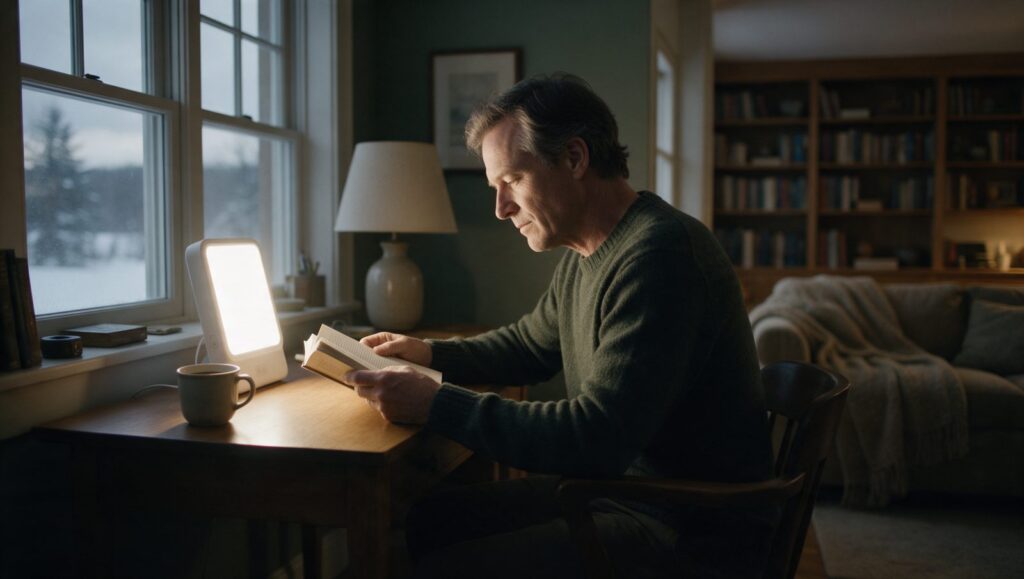
- Keep your eyes open, but don’t stare. Read, eat or work with the light shining toward your eyes from slightly above; Carex’s manual suggests tilting the head about 15° from vertical with your eyes near the center of the screen.
- Be consistent. Use it every day at about the same time, from fall to spring (NIMH). Carex’s manual notes that benefits usually take a few days to appear and that skipped days can bring the old winter pattern back.
- Start gently if bright light bothers you. The Yale clinic suggests 15 minutes a day for a week or two if you feel overstimulated, or sitting farther back for a while if you get eyestrain or a headache.
- Avoid evening sessions. Carex’s manual says use after 8 p.m. may delay sleep. For your evening wind-down, see our sleep stack guide.
- Review it with your clinician after a few weeks. The Yale clinic says four weeks should be long enough to tell if light therapy is working for you, and it argues that makers should offer at least a 2-month trial period so you can return a lamp that doesn’t help.
Side effects, and who should ask a doctor first
Talk to your doctor before you start, especially if you have depression, bipolar disorder (risk of triggering mania), eye conditions, or take photosensitizing medication.
- Common, usually mild side effects. In 83 people using 10,000 lux for 30 minutes a day, the most frequent new symptoms were nausea (15.9%), jumpiness (8.8%) and headache (8.4%), mostly mild (Journal of Clinical Psychiatry, 1999). In a smaller study of 30 people, 26% had visual complaints that faded quickly, 5 of the 8 using evening light had sleep problems, 3 became agitated and 1 had mild hypomania (Journal of Clinical Psychiatry, 1994). The Yale clinic mentions eyestrain and headache, and Carex’s manual adds that overuse may cause irritability, excess energy or trouble falling asleep. Sitting farther back or shortening sessions usually helps.
- Bipolar disorder. Mayo Clinic warns that increasing exposure too fast or using the box too long may induce manic symptoms in people with bipolar disorder. A review of 41 studies with 799 people with bipolar disorder found 0.9% switched into mania and 1.4% into hypomania, rising to 18.8% among 16 people with rapid cycling; the review’s author judged the overall rate similar to what is seen with placebo, but it was much higher in rapid cycling (Psychiatry Research, 2018). The Yale clinic says light treatment should only be done under the supervision of a clinician qualified to treat mood disorders.
- Depression with agitation or dark thoughts. The Yale clinic notes a small number of reports of increased agitation before mood improves, another reason to start under supervision. If you have thoughts of harming yourself, call or text 988.
- Eye conditions. Mayo Clinic advises seeing an eye specialist first if you have glaucoma, cataracts or eye damage from diabetes; the Yale clinic does not recommend bright light treatment for people with retinal diseases such as macular degeneration, says anyone with such an illness or with diabetes should see an eye doctor first, and suggests an eye check for anyone over 65. In a study of 50 patients, eye exams found no changes after short-term use, nor in 17 people after 3 to 6 years of winter use, though the authors recommend periodic eye exams for people with existing eye problems or on photosensitizing drugs (American Journal of Ophthalmology, 1995).
- Photosensitizing medication. The Yale clinic lists some antibiotics (fluoroquinolones, tetracyclines, sulfonamides), antimalarials such as hydroxychloroquine, NSAIDs such as naproxen, and certain antihistamine, antidiabetic, antidepressant and antipsychotic drugs. Northern Light Technologies’ instructions also mention lithium, melatonin, St. John’s wort and retinoic-acid acne creams. Ask your doctor or pharmacist before you start.
- Don’t swap in a skin lamp. Mayo Clinic notes that lamps made for skin disorders mainly produce UV light and could damage your eyes if used incorrectly; a light box for winter mood should filter out most or all UV.
The lamps in detail
Carex Day-Light Classic Plus
- 10,000 lux at 12–14 inches from a 16 × 13-inch screen (Carex); the Yale clinic measured 10,000 lux at 13 inches.
- 192 LEDs, UV-free, 4,000 K, with a 10,000-lux therapy setting and a 5,000-lux task setting. No timer: the manual says not to use therapy mode for more than 60 minutes per session.
- Weighted table-top pedestal with adjustable height and angle, built to shine down from above. Five-year warranty.
- Regulatory note: Carex’s user guide says the lamp “is not a listed medical device in the USA.”
Check the Day-Light Classic Plus on Amazon
Carex Day-Light Sky
- 10,000 lux at 12 inches per its manual (the product page says 12–14 inches); the Yale clinic measured 11,000 lux at 12 inches from a screen of about 13 × 10 inches.
- 192 LEDs, UV-free per the manual, 4,000 K, two settings (therapy and task). No timer. Five-year warranty.
- The manual says sitting farther away, up to about 24 inches, can still help but sessions may need to be longer.
- Regulatory note: its user guide also says it “is not a listed medical device in the USA.”
Check the Day-Light Sky on Amazon
Alaska Northern Lights NorthStar 10,000
- 10,000 lux at 24 inches (maker); the Yale clinic, which lists it among the full-size boxes it recommends, reports this was close to its own measurement.
- Two UV-free fluorescent bulbs, 4,100 K, 140 W; the unit measures 22.5 × 12.5 × 4.5 inches and weighs 10 lbs. Legs or a floor stand cost extra.
- Seven-year warranty for the original owner and a 60-day money-back trial (maker).
- Regulatory note: the maker sells it as a general-wellness product that has not been evaluated by the FDA.
See the NorthStar 10,000 on the maker’s site (not an affiliate link; not found on Amazon on October 13, 2026).
Circadian Optics Langham (Clinical)
- Two sizes: the Standard is rated for 10,000 lux at 12 inches from a 6 × 17-inch panel, the Max for 10,000 lux at 18 inches from a 12 × 22-inch panel (maker). We found no independent measurement.
- UV-free LEDs, 5,500 K and a rotary dimmer; no timer is listed. Four-year replacement policy (maker).
- If you want LED and want to sit farther than a foot away, the Max is the option here that is sold on Amazon.
- Regulatory note: the maker’s pages call it “clinical grade” but make no FDA or medical device statement.
Northern Light Technologies BOXelite
- The product page says 10,000 lux “at up to 14 inches,” while the instruction sheet says to sit 15 to 17 inches from the center of the diffuser; the Yale clinic measured 7,000 lux at about 16 inches from its 15 × 12-inch lit area.
- Two 36 W fluorescent tubes behind a UV filter, “cool white” light (no Kelvin figure given), metal body, legs included. The maker says tubes lose about 15% of their output after 2,000 hours and should then be replaced.
- Seven-year warranty and a 60-day money-back guarantee, less shipping and a $35 restocking fee (maker).
- Regulatory note: no FDA or medical device statement on the maker’s page.
Verilux HappyLight Luxe
- The manual’s fine print rates it at 10,000 lux at 6 inches. It says the lamp can sit from 6 to 24 inches from your face, and that farther away or dimmer settings mean longer sessions. The Yale clinic calls a 6-inch distance not a feasible way to get this intensity for 30 minutes.
- UV-free LEDs, four brightness levels (2,500 to 10,000 lux), three color temperatures (3,500, 4,250 and 5,000 K) and a timer up to 60 minutes. The whole lamp is 11.7 × 7.5 inches and 2 lbs, with a stand and wall mount.
- The manual includes a first-use check: 10 minutes at about 18 inches, stopping and seeing a doctor if the light causes discomfort. Three-year warranty.
- Regulatory note: no FDA or medical device statement in the manual, which warns that some medications and mental health conditions can cause light sensitivity, hyperactivity or hypomania.
Check the HappyLight Luxe on Amazon
Products we looked at but didn’t pick (and why)
- Verilux HappyLight Lucent and Lumi Plus. Two of Verilux’s most popular lamps, but both manuals rate them at 10,000 lux at 6 inches, from even smaller lamps (6.5 × 8.5 inches with the stand, and 9 × 5.6 inches).
- Circadian Optics Lattis and Lumos 2.0. The maker’s pages say 10,000 lux but don’t say at what distance; its how-to page just suggests placing the lamp 6 to 18 inches away.
- Carex Day-Light Elite. Same 12–14-inch rating and a similar 15.75 × 13-inch screen as the Classic Plus, plus a timer and four levels, but it was listed as out of stock on carex.com and did not show up in an Amazon search on October 13, 2026.
- Alaska Northern Lights Aurora LightPad Mini. The maker claims 10,000 lux at 25 inches from a 7.5 × 5.25-inch pad. That is a big claim for a pad that size, and we found no independent measurement to confirm it.
- Blue-light devices. The Yale clinic does not recommend blue light treatment at this time, because blue light is also the most toxic to the retina; it recommends broad-spectrum white light.
- Red light panels and masks. A different tool: red and near-infrared light (roughly 630–850 nm) used for skin and muscle routines, not the bright white light used in winter-mood trials. See our red light therapy devices guide if that is what you are after.
- Sunrise alarm clocks. Wake-up lights brighten gradually; Northern Light Technologies notes they are not 10,000-lux devices. Dawn simulation has its own small evidence base (5 studies in the 2005 meta-analysis), but it is a different setup from a light box.
How we chose
- What we did: read each maker’s product page and user manual on October 13, 2026, and recorded the distance at which it claims 10,000 lux, the light area, UV filtering, color temperature, timer and settings, warranty and any medical device statement. We then cross-checked those claims against the independent measurements published by the Yale School of Medicine’s Winter Depression Research Clinic, and checked availability with an Amazon search on the same day.
- What we did not do: no hands-on review. We did not use these lamps or measure their light ourselves, and no one on our team is a clinician. Where a column says “maker,” it is the maker’s claim.
- How we ranked: first, a stated distance for 10,000 lux of at least about a foot; then a larger light area (easier to stay in the beam), UV-free light, an independent measurement where one exists, the warranty and trial period, and availability in the US. Commissions did not decide the picks: one of our three picks has no affiliate link.
FAQ
How far should a 10,000 lux lamp be from your face?
At the distance the maker says it reaches 10,000 lux, which ranges from 6 inches (HappyLight Luxe) to 24 inches (NorthStar 10,000) among the lamps above. Mayo Clinic’s typical range is 16 to 24 inches, but it says to follow the manufacturer’s instructions. A phone lux app can confirm what reaches your eyes.
How long should you use a light therapy lamp each day?
Mayo Clinic suggests about 20 to 30 minutes at 10,000 lux and NIMH describes about 30 to 45 minutes. Dimmer light needs longer sessions: many experts consider 30 minutes at 10,000 lux roughly equal to 60 minutes at 5,000 lux (Yale). Your doctor can help set the dose.
What time of day is best for a light therapy lamp?
The morning, soon after you wake up. In a 158-person trial, morning light gave more full remissions than evening light by strict criteria, and Carex’s manual warns that use after 8 p.m. may delay sleep.
Can a light therapy lamp replace treatment for seasonal affective disorder?
No. Seasonal affective disorder is a type of depression; NIMH lists light therapy, talk therapy, antidepressants and vitamin D as treatment categories, and a doctor can help you choose and combine them. Light boxes aren’t regulated by the FDA for this use (Mayo Clinic), so use one under medical guidance.
Is a light therapy lamp the same as red light therapy?
No. Light therapy lamps for winter mood give bright, UV-filtered white light that reaches your eyes. Red light devices give red and near-infrared light and are used for skin and muscle routines; compare them in our red light therapy devices guide.
Does a light therapy lamp give you vitamin D?
No. Your skin makes vitamin D when ultraviolet rays from sunlight strike it (NIH Office of Dietary Supplements), and light boxes for winter mood filter out UV (NIMH). NIMH adds that studies of vitamin D as a treatment for seasonal affective disorder have had mixed results. If you are thinking about a supplement, see our vitamin D3 guide or our vitamin D3 + K2 guide.
Related guides
- Best sleep stack 2026: evening habits and supplements that pair with morning light.
- Best vitamin D3 supplement 2026: doses and the upper limit, if your doctor suggests vitamin D for winter.
- Best red light therapy devices 2026: panels, masks and handhelds, a different kind of light therapy.
- Best wellness gifts 2026: if you are thinking of a lamp as a gift, pick one with a stated distance and suggest the person talks to their doctor before starting.
What changed in this update
- October 13, 2026 (2026-10-13): first version. Specs checked on each maker’s website and manual; independent measurements taken from the Yale clinic’s light box page (updated February 4, 2025); Amazon availability checked by search; every study link checked in PubMed.
Sources
- National Institute of Mental Health. Seasonal Affective Disorder (NIH Publication No. 23-MH-8138, revised 2023).
- Mayo Clinic. Seasonal affective disorder treatment: Choosing a light box (March 30, 2022).
- Yale School of Medicine, Winter Depression Research Clinic. How Should I Obtain a Light Box? and What Are the Risks of Light Treatment? (both updated February 4, 2025).
- NIH Office of Dietary Supplements. Vitamin D fact sheet for health professionals.
- Commercially available phototherapy devices for treatment of depression: physical characteristics of emitted light. Psychiatr Res Clin Pract, 2019. PMID 36101875.
- The efficacy of light therapy in the treatment of mood disorders: a review and meta-analysis of the evidence. Am J Psychiatry, 2005. PMID 15800134.
- The efficacy of light therapy in the treatment of seasonal affective disorder: a meta-analysis of randomized controlled trials. Psychother Psychosom, 2020. PMID 31574513.
- The Can-SAD study: a randomized controlled trial of the effectiveness of light therapy and fluoxetine in patients with winter seasonal affective disorder. Am J Psychiatry, 2006. PMID 16648320.
- A controlled trial of timed bright light and negative air ionization for treatment of winter depression. Arch Gen Psychiatry, 1998. PMID 9783557.
- Seasonal affective disorder: common questions and answers. Am Fam Physician, 2020. PMID 33252911.
- Light therapy for preventing seasonal affective disorder. Cochrane Database Syst Rev, 2019. PMID 30883670.
- Bright light therapy: side effects and benefits across the symptom spectrum. J Clin Psychiatry, 1999. PMID 10584776.
- Side effects induced by bright light treatment for seasonal affective disorder. J Clin Psychiatry, 1994. PMID 8071268.
- Rate of switch from bipolar depression into mania after morning light therapy: a historical review. Psychiatry Res, 2018. PMID 29348073.
- Ophthalmologic examination of patients with seasonal affective disorder, before and after bright light therapy. Am J Ophthalmol, 1995. PMID 7832227.
- Maker pages and manuals (checked October 13, 2026): Carex Day-Light Classic Plus (user guide), Carex Day-Light Sky (user guide), NorthStar 10,000, Circadian Optics Langham, BOXelite (instruction sheet), Verilux HappyLight Luxe (user manual).
Level up your recovery
Supplements work best alongside the right recovery tools. Explore our gear guides:
The recovery gear guides
Compare cold plunge, sauna and light therapy gear, reviewed by our team.
- → Best Cold Plunge Tubs 2026
- → Best Cold Plunge Chillers 2026
- → Cold + Sauna Contrast Protocol
- → Best Cold Plunge Cost Guide
- → Best Infrared Saunas 2026
- → Sauna Blanket vs Sauna
- → Best Sauna Blankets 2026
- → Best Red Light Therapy Devices
- → Red Light Panel vs Mask
- → 7 Cold Plunge Benefits (Science)
- → Sauna Benefits for Longevity
- → Red Light Therapy Benefits
- → Cold Plunge Protocol Tool
- → Sauna Routine Calculator
- → Red Light Dosing Calculator
- → Best LED Face Masks 2026