Affiliate links: as an Amazon Associate and through other programs, we earn from qualifying purchases, at no extra cost to you. Learn more.
Updated 2026
Quick answer: Contrast therapy means alternating heat (a sauna) and cold (a cold plunge). Most of the evidence covers each half on its own; the often-quoted 11 minutes of cold a week is what 7 Danish winter-swimming men happened to do, with about 57 minutes of sauna, not a tested dose (Søberg et al., 2021). In a small lab study, a 90-second cold dip between two sauna rounds lowered core temperature and heart rate and made the second round easier to tolerate (Owen et al., 2026).
In This Article
Heat First or Cold First
Most people start in the sauna and alternate. In the lab study above, the cold dip came after each sauna round and made the next round easier to tolerate (Owen et al., 2026). We found no study that compared finishing on cold with finishing on heat, so end with whichever you prefer. If muscle growth is your goal, avoid cold water right after strength training: regular use after lifting reduced strength gains (Malta et al., 2021).
A Common Contrast Routine
| Step | What to do | Time |
|---|---|---|
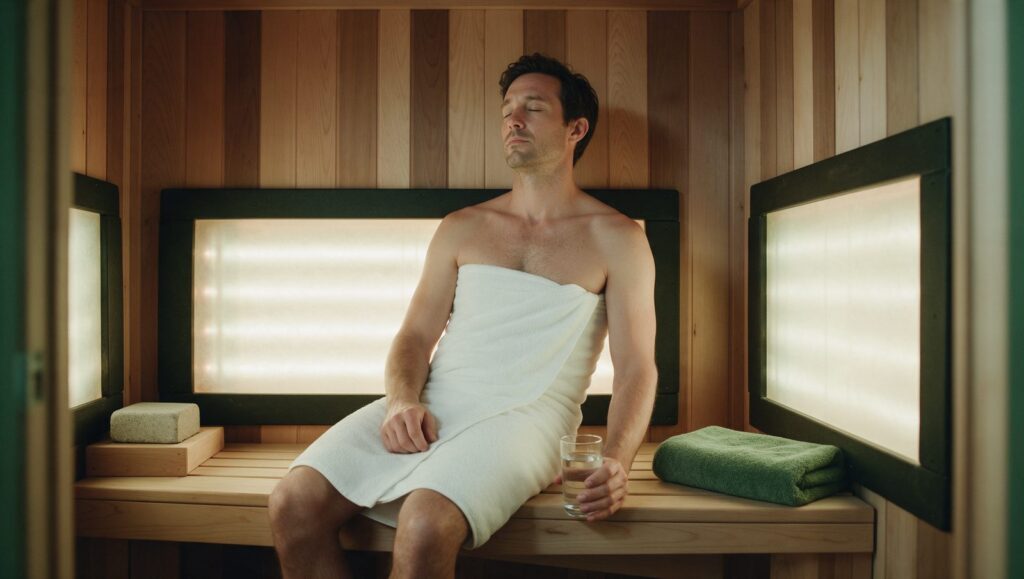
| 1. Heat | Sauna. Finnish saunas run at 80 to 100°C (176 to 212°F) at head height (Laukkanen et al., 2018); infrared saunas run cooler, for example 35 to 50°C (95 to 122°F) (Mero et al., 2015) | Usually 5 to 20 minutes in Finnish saunas; the Danish winter swimmers averaged about 11 minutes per sauna visit (Søberg et al., 2021) |
| 2. Cold | Cold plunge or cold water | Start with a minute or two; the winter swimmers averaged 1.4 minutes per dip |
| 3. Repeat | Alternate heat and cold | The winter swimmers did about 2 sauna visits and 2 to 3 dips per session |
| 4. Finish | Cold or heat, as you prefer | We found no study comparing the two |
Beginners: start with one round. You lose fluid in both: about 0.5% of body weight as sweat in 45 minutes of infrared sauna (Reed et al., 2025), and an hour in cold water raised urine output by 163% (Srámek et al., 2000). Drink water, and never plunge alone.
Get our free supplement cheat sheet.
One page: typical doses, timing and upper limits for ten well-studied supplements. No upsell.
🔒 No spam. Unsubscribe anytime. We send 1-2 emails/month max.
What Contrast Therapy Is Good For
Each half has its own evidence. Cold water after exercise eased muscle soreness compared with rest (Bleakley et al., 2012), and regular Finnish sauna use was linked with fewer cardiovascular deaths in observational studies (Laukkanen et al., 2015). For the combination, the best data come from trials of alternating hot and cold water after exercise: 18 trials, all at high risk of bias, found less soreness and strength loss than resting, and little difference from cold water alone or other methods (Bieuzen et al., 2013). Those trials used water, not a sauna.
How Much Cold and Heat
We found no trial that tested a dose for sauna plus cold plunge. The often-quoted 11 minutes of cold a week is a benchmark from one study: 7 Danish winter-swimming men averaged about 2.6 visits a week, 1.4 minutes per dip and about 57 minutes of sauna a week (Søberg et al., 2021). In a Finnish cohort, men who used a sauna 4 to 7 times a week had a lower risk of sudden cardiac death than once-a-week users, but this was an observational study (Laukkanen et al., 2015).
Safety First
Ask your doctor first if you have heart disease or high blood pressure, or are pregnant. Cold water triggers a cold shock response (fast breathing, racing heart) that raises the risk of drowning and heart rhythm problems (Barwood et al., 2024). Saunas are not advised with unstable angina, a recent heart attack or severe aortic stenosis, and alcohol during a sauna raises the risk of low blood pressure, heart rhythm problems and sudden death (Hannuksela and Ellahham, 2001); in a Korean study, 76 of 103 sauna deaths involved a blood alcohol level of 0.08% or more (Yang et al., 2018). Never plunge alone, and get out if you feel faint.
The gear you need
You need a heat source and a cold source. For heat, see our guides to the best infrared saunas and best sauna blankets. For cold, see the best cold plunge tubs and best chillers.
Frequently Asked Questions
Should I do sauna or cold plunge first?
Most people start with heat and alternate, and in a small lab study a cold dip between sauna rounds made the next round easier to tolerate (Owen et al., 2026). We found no study comparing finishing on cold with finishing on heat.
How long should a contrast therapy session be?
The Danish winter swimmers did about 2 sauna visits of about 11 minutes and 2 to 3 cold dips of about 1.4 minutes per session (Søberg et al., 2021). Beginners should start with one round.
How often should you do contrast therapy?
The winter swimmers went about 2.6 times a week (Søberg et al., 2021); that describes their habit, not a tested dose. If you lift for muscle, keep the cold away from your strength sessions (Malta et al., 2021).
Is contrast therapy better than cold water alone for recovery?
Not in the trials so far: alternating hot and cold water eased soreness more than rest but not more than cold water alone (Bieuzen et al., 2013), and after team sports cold water helped jump recovery while contrast did not (Higgins et al., 2017).
Plan your times and temperatures with our free cold plunge calculator and sauna calculator, and see how the two compare in cold plunge vs sauna.
Scientific References
- Søberg et al., 2021. Altered brown fat thermoregulation and enhanced cold-induced thermogenesis in young, healthy, winter-swimming men. Cell Rep Med.
- Owen et al., 2026. Thermal and cardiovascular responses to sauna are attenuated by adding cold water immersion to cooling breaks. Exp Physiol.
- Malta et al., 2021. The Effects of Regular Cold-Water Immersion Use on Training-Induced Changes in Strength and Endurance Performance: A Systematic Review with Meta-Analysis. Sports Med.
- Laukkanen et al., 2018. Sauna bathing is associated with reduced cardiovascular mortality and improves risk prediction in men and women: a prospective cohort study. BMC Med.
- Mero et al., 2015. Effects of far-infrared sauna bathing on recovery from strength and endurance training sessions in men. Springerplus.
- Reed et al., 2025. Muscle temperature increases during a single far infrared sauna session without changes in intestinal temperature. J Appl Physiol (1985).
- Srámek et al., 2000. Human physiological responses to immersion into water of different temperatures. Eur J Appl Physiol.
- Bleakley et al., 2012. Cold-water immersion (cryotherapy) for preventing and treating muscle soreness after exercise. Cochrane Database Syst Rev.
- Laukkanen et al., 2015. Association between sauna bathing and fatal cardiovascular and all-cause mortality events. JAMA Intern Med.
- Bieuzen et al., 2013. Contrast water therapy and exercise induced muscle damage: a systematic review and meta-analysis. PLoS One.
- Barwood et al., 2024. Habituation of the cold shock response: A systematic review and meta-analysis. J Therm Biol.
- Hannuksela and Ellahham, 2001. Benefits and risks of sauna bathing. Am J Med.
- Yang et al., 2018. Characteristics of sauna deaths in Korea in relation to different blood alcohol concentrations. Forensic Sci Med Pathol.
- Higgins et al., 2017. Effects of Cold Water Immersion and Contrast Water Therapy for Recovery From Team Sport: A Systematic Review and Meta-analysis. J Strength Cond Res.

The recovery gear guides
Compare cold plunge, sauna and light therapy gear, reviewed by our team.
- → Best Cold Plunge Tubs 2026
- → Best Cold Plunge Chillers 2026
- → Best Cold Plunge Cost Guide
- → Best Infrared Saunas 2026
- → Sauna Blanket vs Sauna
- → Best Sauna Blankets 2026
- → Best Red Light Therapy Devices
- → Red Light Panel vs Mask
- → 7 Cold Plunge Benefits (Science)
- → Sauna Benefits for Longevity
- → Red Light Therapy Benefits
- → Cold Plunge Protocol Tool
- → Sauna Routine Calculator
- → Red Light Dosing Calculator
- → Best LED Face Masks 2026
- → Best Light Therapy Lamps 2026