Affiliate links: as an Amazon Associate and through other programs, we earn from qualifying purchases, at no extra cost to you. Learn more.
Quick answer: A cold plunge and an ice bath are the same thing, cold-water immersion; an ice bath just uses ice to make the water colder. Colder was not better for soreness: a 2016 meta-analysis found the best results at 11 to 15°C (52 to 59°F) for 11 to 15 minutes (Machado et al., 2016), and in a 2023 meta-analysis of 44 studies the water temperature did not change the effect (Batista et al., 2023). Colder water is a bigger shock to the body, so start at the warmer end (Srámek et al., 2000).
In This Article
Same Practice, Different Temperature
Both names describe sitting in cold water. People usually say cold plunge when a tub or chiller keeps the water at about 10 to 15°C (50 to 59°F), and ice bath when bags of ice bring it colder. Researchers call both cold-water immersion: the Cochrane review of recovery trials defined it as water below 15°C (59°F) (Bleakley et al., 2012).
What Colder Water Changes
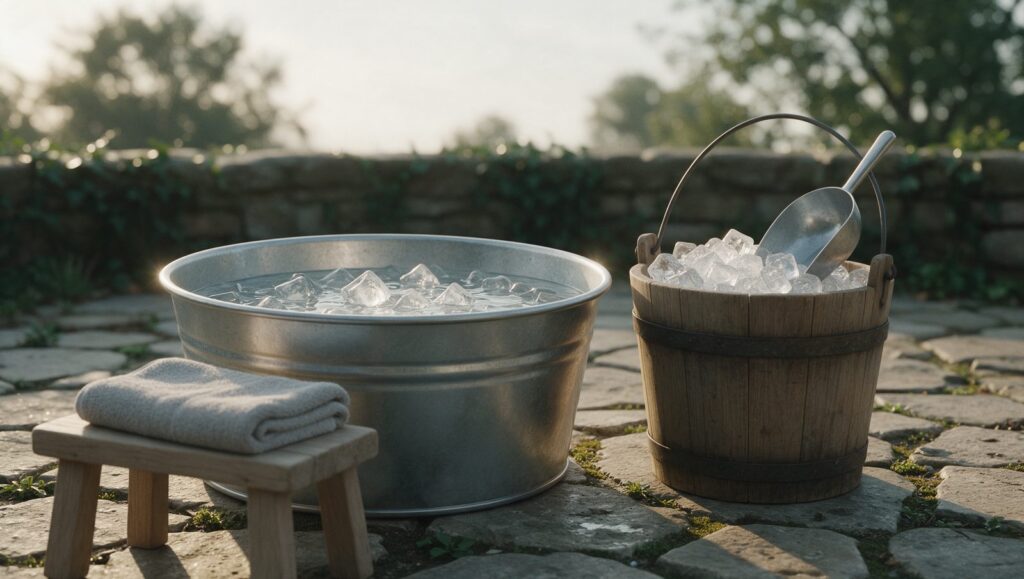
Colder water is a bigger shock. In young men who sat in water for an hour, metabolic rate rose by 93% at 20°C and by 350% at 14°C; at 14°C, noradrenaline rose by 530% and dopamine by 250%, and heart rate and blood pressure went up (Srámek et al., 2000). A home plunge is much shorter than an hour, but even a 36-second dip in near-freezing river water raised noradrenaline in winter swimmers (Huttunen et al., 2001).
Get our free supplement cheat sheet.
One page: typical doses, timing and upper limits for ten well-studied supplements. No upsell.
🔒 No spam. Unsubscribe anytime. We send 1-2 emails/month max.
For recovery, colder was not better. A 2016 meta-analysis of 9 trials found the best soreness results at 11 to 15°C for 11 to 15 minutes (Machado et al., 2016), and a 2023 meta-analysis of 44 studies found that the water temperature did not change the effect (Batista et al., 2023). A 2017 review lists drowning, cardiac arrest and hypothermia among the dangers of cold-water immersion (Tipton et al., 2017).
Your body also adapts. In winter swimmers, the noradrenaline rise after a short dip was smaller after 3 months of regular swimming (Huttunen et al., 2001).
Key Differences at a Glance
| Feature | Cold plunge | Ice bath |
|---|---|---|
| Usual water temperature | About 10 to 15°C (50 to 59°F) | Colder, often below 10°C (50°F), depending on how much ice you add |
| How the water gets cold | A chiller, or a tub filled with cold water | Bags of ice added to the water |
| Soreness after exercise | Same trials: less soreness than rest (Bleakley et al., 2012) | Same trials; colder water did not work better (Batista et al., 2023) |
| Main risks | Drowning, cardiac arrest and hypothermia (Tipton et al., 2017) | The same, with a stronger stress response at lower temperatures (Srámek et al., 2000) |
| Running cost | Electricity for the chiller | Ice for every session |
Which One to Choose
- For recovery after hard exercise, either works. Reviews that ranked protocols put about 10 to 15 minutes at 11 to 15°C first for soreness (Wang et al., 2025), so the coldest water is not needed.
- If you lift to build muscle, keep cold water away from your strength sessions: regular cold water after lifting reduced strength gains (Malta et al., 2021). Our cold plunge before or after a workout page covers timing.
- If you are new to cold water, start at the warmer end with short dips and build up; our cold plunge protocol tool suggests a starting point.
- If you plan to plunge most days, a tub with a chiller saves buying ice: our cold plunge tub guide compares the main types, and our cold plunge cost guide compares running costs.
Using Both in One Session
There is little reason to do a plunge and then an ice bath in the same session, because they are the same practice. Longer sessions did not help soreness in a 44-study meta-analysis (Batista et al., 2023), and cold water carries the risks above (Tipton et al., 2017). If you want to combine cold with heat instead, see our cold plunge and sauna contrast protocol.
Safety
Ask your doctor first if you have heart disease, high blood pressure or Raynaud’s, or are pregnant. Never plunge alone when you are starting, and get out if you feel numb or dizzy or shiver hard.
Frequently Asked Questions
Is an ice bath better than a cold plunge?
Not for soreness: in a 44-study meta-analysis the water temperature did not change the effect (Batista et al., 2023), and an earlier meta-analysis found the best results at 11 to 15°C (Machado et al., 2016).
What temperature counts as an ice bath?
There is no official cutoff. Recovery trials defined cold-water immersion as water below 15°C (59°F) (Bleakley et al., 2012), and people usually call it an ice bath when ice brings the water below about 10°C (50°F).
How long should I stay in?
Short and medium sessions eased soreness and longer ones did not (Batista et al., 2023), and ranked protocols put about 10 to 15 minutes first, with low certainty (Wang et al., 2025). Beginners should start much shorter.
Can I take an ice bath every day?
Daily cold water changes your response: in winter swimmers, the noradrenaline rise after a short dip was smaller after 3 months (Huttunen et al., 2001). If you lift for muscle growth, keep cold water away from your strength sessions (Malta et al., 2021).
Do I need ice if I have a chiller?
No. A chiller holds the water at the temperature you set, so you get the same cold-water immersion without buying ice.
Scientific References
- Machado et al., 2016. Can Water Temperature and Immersion Time Influence the Effect of Cold Water Immersion on Muscle Soreness? A Systematic Review and Meta-Analysis. Sports Med.
- Batista et al., 2023. What Parameters Influence the Effect of Cold-Water Immersion on Muscle Soreness? An Updated Systematic Review and Meta-Analysis. Clin J Sport Med.
- Srámek et al., 2000. Human physiological responses to immersion into water of different temperatures. Eur J Appl Physiol.
- Bleakley et al., 2012. Cold-water immersion (cryotherapy) for preventing and treating muscle soreness after exercise. Cochrane Database Syst Rev.
- Huttunen et al., 2001. Effect of regular winter swimming on the activity of the sympathoadrenal system before and after a single cold water immersion. Int J Circumpolar Health.
- Tipton et al., 2017. Cold water immersion: kill or cure? Exp Physiol.
- Wang et al., 2025. Impact of different doses of cold water immersion (duration and temperature variations) on recovery from acute exercise-induced muscle damage: a network meta-analysis. Front Physiol.
- Malta et al., 2021. The Effects of Regular Cold-Water Immersion Use on Training-Induced Changes in Strength and Endurance Performance: A Systematic Review with Meta-Analysis. Sports Med.
The recovery gear guides
Compare cold plunge, sauna and light therapy gear, reviewed by our team.
- → Best Cold Plunge Tubs 2026
- → Best Cold Plunge Chillers 2026
- → Cold + Sauna Contrast Protocol
- → Best Cold Plunge Cost Guide
- → Best Infrared Saunas 2026
- → Sauna Blanket vs Sauna
- → Best Sauna Blankets 2026
- → Best Red Light Therapy Devices
- → Red Light Panel vs Mask
- → 7 Cold Plunge Benefits (Science)
- → Sauna Benefits for Longevity
- → Red Light Therapy Benefits
- → Cold Plunge Protocol Tool
- → Sauna Routine Calculator
- → Red Light Dosing Calculator
- → Best LED Face Masks 2026
- → Best Light Therapy Lamps 2026