Affiliate links: as an Amazon Associate and through other programs, we earn from qualifying purchases, at no extra cost to you. Learn more.
Quick answer: Traditional saunas heat the air, usually to 80 to 100°C (176 to 212°F), and they have the long-term data: in Finnish cohort studies, people who used them most often had fewer cardiovascular deaths, although these studies are observational (Laukkanen et al., 2018). Infrared saunas run cooler and have mostly short trials in heart failure, where 15 minutes at 60°C (140°F) for 2 to 4 weeks improved heart measures (Källström et al., 2018). Neither type has been shown in proper trials to clear toxins from the body (Sears et al., 2012).
In This Article
The two types heat you in different ways and have different research behind them. Here is how they compare and who should be careful with either. If you are shopping, our infrared sauna guide compares cabins, blankets and tents by type and budget.
How Each Type Heats You
A traditional Finnish sauna heats the air, usually to 80 to 100°C at head height, with low humidity of about 10% to 20%; throwing water on the hot stones raises the humidity for a short time (Laukkanen et al., 2018).
Get our free supplement cheat sheet.
One page: typical doses, timing and upper limits for ten well-studied supplements. No upsell.
🔒 No spam. Unsubscribe anytime. We send 1-2 emails/month max.
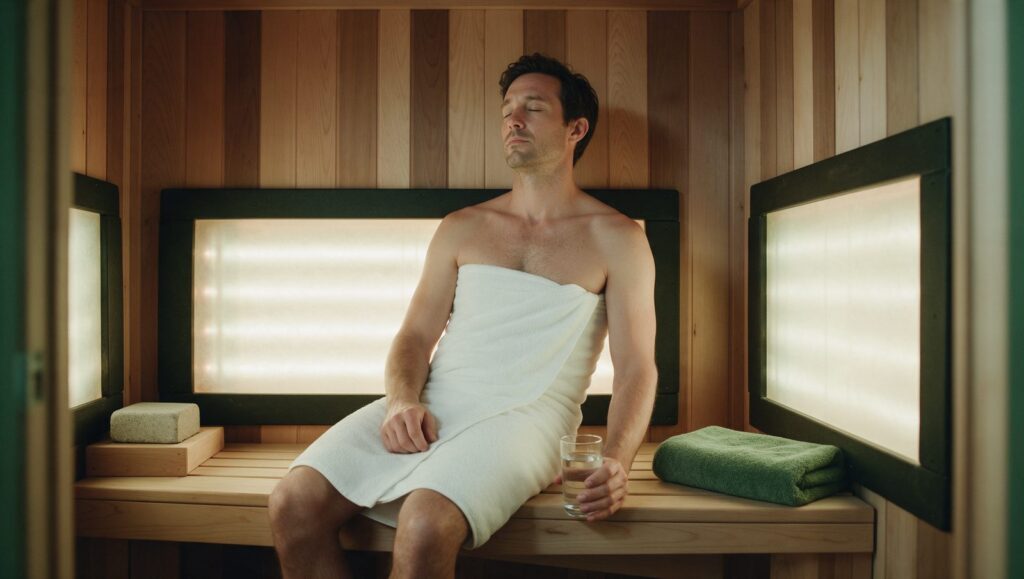
An infrared sauna uses panels that warm your body with radiant heat, so the air can stay cooler: heart failure trials used about 60°C (Källström et al., 2018), and one recovery study used 35 to 50°C (Mero et al., 2015). The heat stays near the surface. In 10 adults who sat in a far-infrared sauna for 45 minutes, muscle temperature rose 3.0°C at 1.4 cm below the skin but only 1.1°C at 3.4 cm, and core temperature did not change (Reed et al., 2025).
What the Research Covers
| Question | Traditional sauna | Infrared sauna |
|---|---|---|
| Long-term health | Finnish cohort studies: 4 to 7 sessions a week linked with less sudden cardiac death and dementia than 1 a week; these are observational (Laukkanen et al., 2015; Laukkanen et al., 2017) | One 5-year study in 129 people with heart failure, not randomized: cardiac events in 31.3% with infrared sessions and 68.7% without (Kihara et al., 2009); no long-term studies in healthy people found |
| Heart failure | No Finnish sauna study met the criteria of a 2018 review (Källström et al., 2018) | 2 to 4 weeks of sessions lowered a heart strain marker (BNP) and improved heart pumping (Källström et al., 2018); symptoms and walking distance improved in a 149-patient trial (Tei et al., 2016) |
| Blood pressure in one session | A 30-minute session at 73°C lowered systolic pressure from 137 to 130 mmHg (Laukkanen et al., 2018) | No change during 45 minutes in 10 healthy women (Hussain et al., 2022) |
Across both types, a 2018 review found 40 clinical studies of regular dry sauna use but only 13 randomized trials, most with fewer than 40 people (Hussain and Cohen, 2018). For the Finnish numbers in detail, see our page on sauna benefits for longevity.
Sweating Out Toxins
Sweat does contain small amounts of metals such as arsenic, cadmium, lead and mercury. A 2012 review of 24 studies found higher levels in the sweat of people with high exposure, but said properly sized trials are still needed before sweating can be used to lower them (Sears et al., 2012). In a small study, sweat collected during running had higher concentrations of nickel, lead, copper and arsenic than sweat collected in a sauna (Kuan et al., 2022). We found no trial comparing infrared and traditional saunas for this (PubMed search, October 24, 2026).
Choosing Between Them
- If you want the type used in the long-term studies, choose a traditional sauna (Laukkanen et al., 2015).
- If high heat is hard for you, an infrared sauna runs cooler (Källström et al., 2018). If space is tight, our sauna blanket vs infrared sauna page compares a blanket with a cabin.
- Whichever you pick, start with short sessions; our sauna routine calculator gives a starting point by goal.
Who Should Be Careful
- Heart disease: sauna use is not advised with unstable angina, a recent heart attack or severe aortic stenosis, although a 2001 review found it safe for most people with stable coronary heart disease (Hannuksela and Ellahham, 2001). Ask your doctor first.
- Low blood pressure: in 102 adults, one 30-minute sauna at 73°C lowered systolic pressure from 137 to 130 mmHg on average (Laukkanen et al., 2018). If you get dizzy when you stand up, leave the sauna slowly and sit down.
- Alcohol: drinking during sauna use raises the risk of low blood pressure, irregular heartbeat and sudden death (Hannuksela and Ellahham, 2001). In a review of 103 sauna deaths in Korea, 76 people had a blood alcohol level of 0.08% or more (Yang et al., 2018).
- Pregnancy: ask your doctor first. A review of 12 studies found that sitting in a 70°C (158°F) dry sauna for up to 20 minutes did not raise pregnant women’s core temperature to the 39°C level linked to birth defects (Ravanelli et al., 2019).
- Men trying to conceive: in one small study of 10 men, regular sauna use lowered sperm production, which recovered after they stopped (Hussain and Cohen, 2018).
Frequently Asked Questions
Is an infrared or a traditional sauna better for your heart?
Traditional saunas have the long-term data, from Finnish cohort studies that are observational (Laukkanen et al., 2018). Infrared has shorter trials, mostly in people with heart failure (Källström et al., 2018).
How hot is an infrared sauna compared with a traditional one?
Traditional saunas usually run at 80 to 100°C at head height (Laukkanen et al., 2018). Infrared studies used about 60°C, and one used 35 to 50°C (Källström et al., 2018; Mero et al., 2015).
Do infrared saunas remove more toxins?
There is no good evidence that either type clears toxins, and a 2012 review said properly sized trials are still needed (Sears et al., 2012). In one small study, sweat from exercise held more metals than sweat from a sauna (Kuan et al., 2022).
Can an infrared sauna replace exercise?
No. In 10 healthy women, 45 minutes in an infrared sauna raised ear temperature more than cycling did, but only cycling raised breathing rate, and the authors concluded that infrared works mainly through heat (Hussain et al., 2022).
How often should I use a sauna?
In the Finnish studies, 4 to 7 sessions a week were linked with the lowest risk, compared with once a week (Laukkanen et al., 2015). Training trials used about 3 sessions a week (Kirby et al., 2021).
Scientific References
- Laukkanen et al., 2018. Sauna bathing is associated with reduced cardiovascular mortality and improves risk prediction in men and women: a prospective cohort study. BMC Med.
- Källström et al., 2018. Effects of sauna bath on heart failure: A systematic review and meta-analysis. Clin Cardiol.
- Sears et al., 2012. Arsenic, cadmium, lead, and mercury in sweat: a systematic review. J Environ Public Health.
- Mero et al., 2015. Effects of far-infrared sauna bathing on recovery from strength and endurance training sessions in men. Springerplus.
- Reed et al., 2025. Muscle temperature increases during a single far infrared sauna session without changes in intestinal temperature. J Appl Physiol (1985).
- Laukkanen et al., 2015. Association between sauna bathing and fatal cardiovascular and all-cause mortality events. JAMA Intern Med.
- Laukkanen et al., 2017. Sauna bathing is inversely associated with dementia and Alzheimer’s disease in middle-aged Finnish men. Age Ageing.
- Kihara et al., 2009. Waon therapy improves the prognosis of patients with chronic heart failure. J Cardiol.
- Tei et al., 2016. Waon Therapy for Managing Chronic Heart Failure - Results From a Multicenter Prospective Randomized WAON-CHF Study. Circ J.
- Laukkanen et al., 2018. Acute effects of sauna bathing on cardiovascular function. J Hum Hypertens.
- Hussain et al., 2022. Infrared sauna as exercise-mimetic? Physiological responses to infrared sauna vs exercise in healthy women: A randomized controlled crossover trial. Complement Ther Med.
- Hussain and Cohen, 2018. Clinical Effects of Regular Dry Sauna Bathing: A Systematic Review. Evid Based Complement Alternat Med.
- Kuan et al., 2022. Excretion of Ni, Pb, Cu, As, and Hg in Sweat under Two Sweating Conditions. Int J Environ Res Public Health.
- Hannuksela and Ellahham, 2001. Benefits and risks of sauna bathing. Am J Med.
- Yang et al., 2018. Characteristics of sauna deaths in Korea in relation to different blood alcohol concentrations. Forensic Sci Med Pathol.
- Ravanelli et al., 2019. Heat stress and fetal risk. Environmental limits for exercise and passive heat stress during pregnancy: a systematic review with best evidence synthesis. Br J Sports Med.
- Kirby et al., 2021. Intermittent post-exercise sauna bathing improves markers of exercise capacity in hot and temperate conditions in trained middle-distance runners. Eur J Appl Physiol.

The recovery gear guides
Compare cold plunge, sauna and light therapy gear, reviewed by our team.
- → Best Cold Plunge Tubs 2026
- → Best Cold Plunge Chillers 2026
- → Cold + Sauna Contrast Protocol
- → Best Cold Plunge Cost Guide
- → Best Infrared Saunas 2026
- → Sauna Blanket vs Sauna
- → Best Sauna Blankets 2026
- → Best Red Light Therapy Devices
- → Red Light Panel vs Mask
- → 7 Cold Plunge Benefits (Science)
- → Sauna Benefits for Longevity
- → Red Light Therapy Benefits
- → Cold Plunge Protocol Tool
- → Sauna Routine Calculator
- → Red Light Dosing Calculator
- → Best LED Face Masks 2026
- → Best Light Therapy Lamps 2026