Affiliate links: as an Amazon Associate and through other programs, we earn from qualifying purchases, at no extra cost to you. Learn more.
Updated 2026
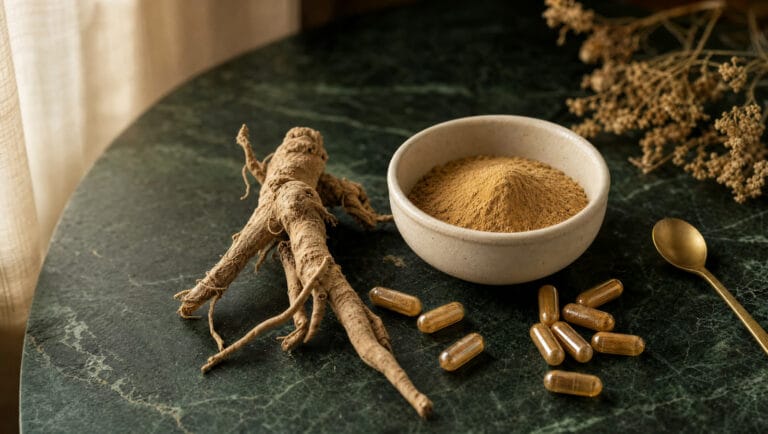
Quick answer: In trials of ashwagandha root extract, adults took 250 to 600 mg a day, often as 300 mg twice a day, for 6 to 12 weeks (Salve et al., 2019; Langade et al., 2019; NIH ODS). Stress benefits looked larger at 500 to 600 mg a day in several studies, and sleep benefits at 600 mg (NIH ODS; Cheah et al., 2021). It may be safe for up to 3 months, its long-term safety is unknown, and it should be avoided in pregnancy and with thyroid or autoimmune disorders (NCCIH).
In This Article
Why the Dose Matters

An ashwagandha dose only makes sense next to the extract it was tested with: extracts differ in the plant part used and in how concentrated they are. For example, one sleep trial used 120 mg a day of one extract (Deshpande et al., 2020) and another used 600 mg a day of a different one (Langade et al., 2019). Ashwagandha may be safe for up to 3 months, but its long-term safety is unknown (NCCIH).
Ashwagandha supplements compared: extract and dose (2026)
| Product | On the label | Good to know | Buy |
|---|---|---|---|
| Our pick Nutricost KSM-66 Ashwagandha | 600 mg KSM-66 root extract (min. 5% withanolides) + 5 mg BioPerine per capsule | The extract and the 600 mg daily dose used in several clinical trials. | See it on Amazon ↗ |
| NOW KSM-66 Ashwagandha | 600 mg KSM-66 root extract per capsule | The same extract and dose, without black pepper extract. | See it on Amazon ↗ |
| Life Extension Optimized Ashwagandha | 125 mg Sensoril extract per capsule | A different extract (root and leaf) that is dosed lower, usually 125 to 250 mg a day. | See it on Amazon ↗ |
| Organic India Ashwagandha | 800 mg organic ashwagandha per 2 capsules | No withanolide percentage on the label, so it is not a standardized extract. | See it on Amazon ↗ |
Not for use in pregnancy, and rare cases of liver injury have been reported (NCCIH).
Label figures: NIH Dietary Supplement Label Database and the brand listing, checked October 2026. Formulas change, so check the label before you buy. We earn a commission on Amazon purchases at no extra cost to you, and we do not lab-test products.
Doses Used in Trials
The trials reviewed by the NIH used 240 to 1,250 mg a day of extract for stress and 120 to 600 mg a day for sleep (NIH ODS).
Get our free supplement cheat sheet.
One page: typical doses, timing and upper limits for ten well-studied supplements. No upsell.
🔒 No spam. Unsubscribe anytime. We send 1-2 emails/month max.
- Stress (250 to 600 mg a day of KSM-66): in an 8-week trial, both 250 and 600 mg a day lowered perceived stress and cortisol compared with placebo, but anxiety scores fell only at 600 mg (Salve et al., 2019); in several studies, benefits looked larger at 500 to 600 mg a day (NIH ODS).
- Sleep (120 to 600 mg a day): across 5 trials the benefit was small, and larger at 600 mg a day and with at least 8 weeks of use (Cheah et al., 2021). See ashwagandha for sleep.
- Higher doses: multi-gram doses of extract have not been tested in these trials, and one case of thyrotoxicosis (an overactive thyroid) involved an unusually high 1,950 mg a day (NIH ODS).
Timing: When to Take It
- Once or twice a day: trials gave it once a day (Deshpande et al., 2020; Lopresti et al., 2019) or split into two doses, for example 300 mg twice a day (Salve et al., 2019; Langade et al., 2019).
- With food: two of the main trials gave it after food (Chandrasekhar et al., 2012; Salve et al., 2019). No trial compared morning with evening; see the best time to take ashwagandha.
Which Extract to Choose
Match your label to an extract that was tested, at the dose that was tested:
- KSM-66: root only, at least 5% withanolides; 250 to 600 mg a day in trials (Chandrasekhar et al., 2012; Salve et al., 2019).
- Sensoril: root and leaf, water extract; 125 to 500 mg a day (Pandit et al., 2024).
- Shoden: root and leaf; 120 to 240 mg once a day (NIH ODS; Deshpande et al., 2020; Lopresti et al., 2019).
The makers supplied the extract for the KSM-66 trials (Chandrasekhar et al., 2012; Salve et al., 2019) and paid for the Sensoril trial (Pandit et al., 2024) and the 240 mg Shoden trial (Lopresti et al., 2019). We found no trial showing that adding black pepper extract improves the effects of ashwagandha (PubMed search, October 2026). See KSM-66 vs Sensoril.
Special Populations
- Athletes: two small trials with weight training found larger strength gains than placebo, with 600 mg a day of root extract for 8 weeks (Wankhede et al., 2015) and 500 mg a day of a root and leaf extract for 12 weeks, paid for by its maker (Ziegenfuss et al., 2018); the NIH says the evidence on athletic performance is not enough (NCCIH).
- Memory and focus: two small trials reported better memory test scores, one in 50 adults with mild cognitive impairment (Choudhary et al., 2017) and one in 130 stressed adults aged 20 to 55, by authors who work for supplement companies (Gopukumar et al., 2021); the NIH says the evidence on cognitive function is not enough (NCCIH).
- Pregnancy and breastfeeding: avoid it (NCCIH).
- Thyroid or autoimmune disorders, upcoming surgery, hormone-sensitive prostate cancer: avoid it (NCCIH).
Side Effects and Warning Signs
- Common side effects: drowsiness, stomach upset, diarrhea and vomiting are possible (NCCIH); in trials they were usually mild (NIH ODS).
- Thyroid: case reports describe thyrotoxicosis (an overactive thyroid) after taking ashwagandha (van der Hooft et al., 2005; Kamal et al., 2022); see a doctor if your heart races.
- Liver: rare cases of liver injury have been linked to ashwagandha (NCCIH); in a case series, jaundice appeared 2 to 12 weeks after starting (Björnsson et al., 2020). Stop taking it and see a doctor if your skin or eyes turn yellow.
Dosing Table
| Goal | Daily dose (as studied) | Timing | Duration |
|---|---|---|---|
| Stress relief | 250 to 600 mg root extract (larger effects at 500 to 600 mg in several studies) (Salve et al., 2019; NIH ODS) | Once daily or split into two doses | 6 to 8 weeks in the trials reviewed by the NIH (NIH ODS) |
| Sleep quality | 250 to 600 mg root extract (best results at 600 mg), or 120 mg of Shoden (Cheah et al., 2021; Deshpande et al., 2020) | Often split, for example 300 mg twice a day (Langade et al., 2019) | At least 8 weeks for best results (Cheah et al., 2021) |
| Memory and focus | 300 to 600 mg root extract in two small trials (Choudhary et al., 2017; Gopukumar et al., 2021) | Once daily or split into two doses | 8 weeks to 90 days; the NIH says the evidence is not enough (NCCIH) |
| Fatigue | 400 mg (200 mg twice a day) in one trial: fatigue fell, perceived stress did not differ from placebo (Smith et al., 2023) | Twice daily | 12 weeks; paid for by an ingredient company |
| Any goal: safety | Stay within studied doses | No timing rule | Well tolerated for up to about 3 months; long-term safety unknown (NIH ODS) |
Medicines and Other Supplements
- Thyroid medicines: ashwagandha might interact with thyroid hormone medicines (NIH ODS).
- Other medicines: it might also interact with medicines for diabetes and blood pressure, immunosuppressants, sedatives and anti-seizure drugs (NCCIH).
- Other herbs: we found no trials showing that bacopa or ginseng add to the effects of ashwagandha (PubMed search, October 2026).
In Short
- Match the dose to the extract: trials used KSM-66 at 250 to 600 mg, Sensoril at 125 to 500 mg and Shoden at 120 to 240 mg a day (Salve et al., 2019; Pandit et al., 2024; Deshpande et al., 2020; Lopresti et al., 2019).
- Expect modest effects: a small drop in cortisol (Albalawi, 2025) and a small sleep benefit (Cheah et al., 2021).
- Give it about 8 weeks: sleep benefits were larger after at least 8 weeks (Cheah et al., 2021), and safety beyond about 3 months is unknown (NCCIH).
- Skip it in pregnancy and breastfeeding and with thyroid or autoimmune disorders (NCCIH).
Talk to your doctor before adding ashwagandha if you take any medicines.
Ashwagandha is one of the better-studied adaptogens. Several trials found a modest drop in cortisol; results for perceived stress are mixed and the testosterone evidence is limited (NIH). Choose an extract tested in trials (KSM-66, Sensoril or Shoden), use it for up to 3 months, and skip it if you have a thyroid or autoimmune condition, liver problems, or are pregnant.
Scientific References
- Salve et al., 2019. Adaptogenic and Anxiolytic Effects of Ashwagandha Root Extract in Healthy Adults: A Double-blind, Randomized, Placebo-controlled Clinical Study. Cureus.
- Langade et al., 2019. Efficacy and Safety of Ashwagandha (Withania somnifera) Root Extract in Insomnia and Anxiety: A Double-blind, Randomized, Placebo-controlled Study. Cureus.
- Cheah et al., 2021. Effect of Ashwagandha (Withania somnifera) extract on sleep: A systematic review and meta-analysis. PLoS One.
- Deshpande et al., 2020. A randomized, double blind, placebo controlled study to evaluate the effects of ashwagandha (Withania somnifera) extract on sleep quality in healthy adults. Sleep Med.
- Lopresti et al., 2019. An investigation into the stress-relieving and pharmacological actions of an ashwagandha (Withania somnifera) extract: A randomized, double-blind, placebo-controlled study. Medicine (Baltimore).
- Chandrasekhar et al., 2012. A prospective, randomized double-blind, placebo-controlled study of safety and efficacy of a high-concentration full-spectrum extract of ashwagandha root in reducing stress and anxiety in adults. Indian J Psychol Med.
- Pandit et al., 2024. Effects of Withania somnifera Extract in Chronically Stressed Adults: A Randomized Controlled Trial. Nutrients.
- Wankhede et al., 2015. Examining the effect of Withania somnifera supplementation on muscle strength and recovery: a randomized controlled trial. J Int Soc Sports Nutr.
- Ziegenfuss et al., 2018. Effects of an Aqueous Extract of Withania somnifera on Strength Training Adaptations and Recovery: The STAR Trial. Nutrients.
- Choudhary et al., 2017. Efficacy and Safety of Ashwagandha (Withania somnifera (L.) Dunal) Root Extract in Improving Memory and Cognitive Functions. J Diet Suppl.
- Gopukumar et al., 2021. Efficacy and Safety of Ashwagandha Root Extract on Cognitive Functions in Healthy, Stressed Adults: A Randomized, Double-Blind, Placebo-Controlled Study. Evid Based Complement Alternat Med.
- van der Hooft et al., 2005. [Thyrotoxicosis following the use of ashwagandha]. Ned Tijdschr Geneeskd.
- Kamal et al., 2022. Ashwagandha as a Unique Cause of Thyrotoxicosis Presenting With Supraventricular Tachycardia. Cureus.
- Björnsson et al., 2020. Ashwagandha-induced liver injury: A case series from Iceland and the US Drug-Induced Liver Injury Network. Liver Int.
- Smith et al., 2023. Exploring the efficacy and safety of a novel standardized ashwagandha (Withania somnifera) root extract (Witholytin®) in adults experiencing high stress and fatigue in a randomized, double-blind, placebo-controlled trial. J Psychopharmacol.
- Albalawi, 2025. Dual impact of Ashwagandha: Significant cortisol reduction but no effects on perceived stress: A systematic review and meta-analysis. Nutr Health.
- National Center for Complementary and Integrative Health: Ashwagandha (last updated March 2023).
- NIH Office of Dietary Supplements: Ashwagandha, fact sheet for health professionals (updated May 2, 2025).