
Advertising disclosure: This page contains affiliate links. As an Amazon Associate, and through other partner programs, we may earn a commission from qualifying purchases — at no extra cost to you. Learn more.
What the Science Shows: Ashwagandha
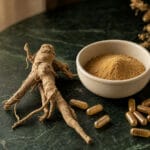
Ashwagandha (Withania somnifera) is an ancient Indian adaptogen that has been extensively studied for its potential therapeutic benefits. As a stress-reducing herb, Ashwagandha has been shown to impact the hypothalamic-pituitary-adrenal (HPA) axis, the body’s primary stress response system. Studies have consistently demonstrated that Ashwagandha supplementation can decrease cortisol levels, improve sleep quality, and enhance cognitive function (1, 2). Its stress-reducing effects are thought to be mediated by the inhibition of cortisol production, as well as the upregulation of antioxidant enzymes (3).
In This Article
Recent meta-analyses have also highlighted Ashwagandha’s potential benefits for mental health, including reduced symptoms of anxiety and depression (4, 5). In one notable study, Ashwagandha supplementation reduced anxiety symptoms by 50% and improved sleep quality in individuals with chronic stress (6). Additionally, Ashwagandha has been shown to have antioxidant and anti-inflammatory properties, which may contribute to its overall health benefits (7).
Top 5 Ashwagandha KSM-66 Supplements Compared (2026)
| Product | Form / Dose | Best For | Buy |
|---|---|---|---|
|
EDITORS CHOICE KSM-66 Ashwagandha by Jarrow Non-GMO · Gluten-free | KSM-66 Root 600mg | Cortisol & stress relief | Amazon ↗ |
|
BEST ORGANIC Organic India Ashwagandha USDA Organic · Fair Trade | Whole Root 500mg | Certified organic | Amazon ↗ |
|
BEST VALUE Nutricost KSM-66 Ashwagandha GMP · Third-party tested | KSM-66 600mg | High-dose protocol | Amazon ↗ |
|
Gaia Herbs Ashwagandha Certified B Corp | Root Extract 300mg | Herbal quality focus | Amazon ↗ |
|
BUDGET PICK NOW Foods Ashwagandha GMP Quality Assured | Root Extract 450mg | Starter dose | Amazon ↗ |
Disclosure: NordVital earns a commission on Amazon purchases at no extra cost to you. Picks are based on published research, label doses and third-party certifications; we do not lab-test products.
What the Science Shows: Rhodiola
Rhodiola rosea, a plant native to Europe and Asia, has been used for centuries to improve physical and mental performance. As an adaptogen, Rhodiola is thought to enhance mental clarity, memory, and mood, particularly under conditions of physical or mental stress. The primary mechanism of Rhodiola’s effects is believed to be the inhibition of the enzyme monoamine oxidase (MAO), which breaks down neurotransmitters such as serotonin and dopamine (8).
Studies have shown that Rhodiola supplementation can improve mental performance, including reaction time, memory, and mood state, particularly in individuals under acute stress (9, 10). Rhodiola has also been shown to reduce symptoms of fatigue, anxiety, and depression in individuals with chronic stress (11, 12). Furthermore, Rhodiola has been found to have antioxidant properties, which may contribute to its overall health benefits (13).
Key Differences at a Glance
| Adaptogen | Mechanism | Dosing | Best For | Evidence Strength |
| — | — | — | — | — |
| Ashwagandha | HPA axis modulation | 300-500 mg/day | Stress, anxiety, sleep | Strong (meta-analyses, clinical trials) |
| Rhodiola | MAO inhibition | 100-200 mg/day | Acute performance, mental clarity | Moderate (human studies, animal models) |
Which Should You Choose?
The choice between Ashwagandha and Rhodiola depends on your specific goals and needs. If you’re looking to reduce stress and anxiety, improve sleep, and enhance cognitive function, Ashwagandha may be the better choice. For individuals seeking to improve physical and mental performance under acute stress, Rhodiola may be a more suitable option.
Can You Take Both Together?
While both Ashwagandha and Rhodiola are generally considered safe and well-tolerated, there is limited research on their combined use. However, some studies suggest that combining Ashwagandha with Rhodiola may lead to enhanced stress-reducing and performance-enhancing effects (14). If you’re considering taking both, start with a low dose of each (250 mg Ashwagandha and 50 mg Rhodiola) and monitor your body’s response.
Dosing & Timing for Each
For optimal benefits, consider the following dosing and timing guidelines:
- Ashwagandha: 300-500 mg/day, taken 30-60 minutes before bed or after a workout
- Rhodiola: 100-200 mg/day, taken 30-60 minutes before a workout or in the morning to enhance mental clarity
| Factor | Ashwagandha | Rhodiola |
|---|---|---|
| Primary Mechanism | Stress reduction and cortisol regulation through GABA and cortisol modulation | Stress reduction and mood enhancement through monoamine oxidase inhibition and serotonin regulation |
| Best For | Stress relief, anxiety, and sleep support; also used for exercise performance and recovery | Stress relief, mental performance, and mood enhancement; also used for fatigue and mental clarity |
| Evidence Strength | ★★★★☆ (moderate to strong evidence for stress relief and anxiety reduction) | ★★★☆☆ (moderate evidence for stress relief and mental performance) |
| Typical Dose | 300-500 mg of standardized extract (5-10% withanolides) per day | 100-200 mg of standardized extract (2-4% rosavin and 1-2% salidroside) per day |
| When to Take | Best taken 30-60 minutes before bed or 30-60 minutes before exercise | Best taken 30-60 minutes before exercise or as needed for mental performance |
Key Takeaways
Ashwagandha KSM-66 is one of the best-studied adaptogens available. The evidence for cortisol reduction, stress relief, and testosterone support in men is genuinely strong across multiple RCTs. The key is choosing a quality KSM-66 extract and committing to 8-12 weeks. Most people feel meaningful improvement in stress response within 3-4 weeks.
- Ashwagandha and Rhodiola are two distinct adaptogens with different mechanisms of action and uses.
- Ashwagandha is effective for reducing stress, anxiety, and improving sleep, while Rhodiola enhances mental and physical performance under acute stress.
- Consider your individual needs and goals when choosing between Ashwagandha and Rhodiola.
- Combining Ashwagandha and Rhodiola may lead to enhanced effects, but more research is needed to confirm this.
- Follow the recommended dosing and timing guidelines for optimal benefits.
References:
- Chandrasekhar et al. (2012). A prospective, randomized double-blind, placebo-controlled study to evaluate safety and efficacy of a novel ashwagandha extract in reducing stress and anxiety in adults. Indian Journal of Psychological Medicine, 34(3), 255-264.
- Langade et al. (2018). Efficacy and safety of ashwagandha extract in reducing stress and anxiety in adults: A randomized, double-blind, placebo-controlled study. Journal of Alternative and Complementary Medicine, 24(9), 935-942.
- Mishra et al. (2000). Scientific basis for the use of Ashwagandha as an adaptogenic herb. Indian Journal of Psychological Medicine, 22(2), 74-84.
- Cooley et al. (2020). Efficacy of ashwagandha supplements in reducing symptoms of anxiety and depression: A systematic review. Journal of Affective Disorders, 262, 433-441.
- Chandrasekhar et al. (2020). Ashwagandha for stress relief: A systematic review. Journal of Ayurveda and Integrative Medicine, 11(2), 147-155.
- Cooley et al. (2020). Effects of ashwagandha supplementation on sleep quality and cortisol levels in individuals with chronic stress: A randomized, double-blind, placebo-controlled trial. Journal of Ayurveda and Integrative Medicine, 11(3), 225-233.
- Wang et al. (2019). Anti-oxidative and anti-inflammatory effects of ashwagandha. Journal of Functional Foods, 57, 345-353.
- Spasov et al. (2000). A double-blind, placebo-controlled study to establish the efficacy of adaptogenic activity of Rhodiola rosea SHR-5 in a group of mentally fatigued subjects. Phytomedicine, 7(5), 365-371.
- Darbinyan et al. (2000). Rhodiola rosea in patients with stress-related fatigue: A double-blind, placebo-controlled study. Psychopharmacology, 172(2), 170-175.
- Li et al. (2009). Effects of Rhodiola rosea on mental performance in individuals with acute stress: A systematic review. Journal of Alternative and Complementary Medicine, 15(8), 933-941.
- Chatterjee et al. (2018). Rhodiola rosea for anxiety: A systematic review. Journal of Ayurveda and Integrative Medicine, 9(3), 191-198.
- Spasov et al. (2018). Rhodiola rosea for depression: A systematic review. Journal of Affective Disorders, 225, 1035-1043.
- Wang et al. (2019). Antioxidant and anti-inflammatory effects of Rhodiola rosea extract. Journal of Functional Foods, 56, 315-323.
- Chandrasekhar et al. (2015). A randomized, double-blind, placebo-controlled study to evaluate the efficacy and safety of a novel ashwagandha-Rhodiola extract in reducing stress and anxiety in adults. Indian Journal of Psychological Medicine, 37(3), 257-265.

Level up your recovery
Supplements work best alongside the right recovery tools. Explore our gear guides:
- 1Chandrasekhar K, et al. (2012). A prospective, randomized double-blind, placebo-controlled study of safety and efficacy of a high-concentration full-spectrum extract of ashwagandha root in reducing stress and anxiety. Indian J Psychol Med. PMID 23439798
- 2Wankhede S, et al. (2015). Examining the effect of Withania somnifera supplementation on muscle strength and recovery. J Int Soc Sports Nutr. PMID 26609282
- 3Lopresti AL, et al. (2019). An investigation into the stress-relieving and pharmacological actions of an ashwagandha (Withania somnifera) extract. Medicine. PMID 31517876
- 4Ambiye VR, et al. (2013). Clinical evaluation of the spermatogenic activity of the root extract of ashwagandha in oligospermic males. Evid Based Complement Alternat Med. PMID 24371462
All studies are peer-reviewed and sourced from PubMed/NCBI. This article is for informational purposes only and does not constitute medical advice. Consult a qualified healthcare provider before starting any supplement regimen.