Affiliate links: as an Amazon Associate and through other programs, we earn from qualifying purchases, at no extra cost to you. Learn more.
Both infrared and traditional Finnish saunas deliver real health benefits — but they work via different mechanisms. Here’s an evidence-based comparison to help you choose the right one for your goals.
In This Article
- How They Work — Mechanism Differences
- What the Evidence Shows
- Choose Based on Your Goal
- Optimal Protocol
- Safety Considerations
- Frequently Asked Questions
- Quick Comparison Table
- How Each Type Works
- Health Effects — Where Each Wins
- Which Should You Choose?
- Sauna Blankets — A Third Option
- FAQ
- Head-to-Head: Infrared vs Traditional Sauna (2026 Evidence)
- Sauna Protocols by Goal
- Sauna Comparison Cheatsheet
- Sauna FAQ
How They Work — Mechanism Differences
Traditional sauna (90-100°C): Heats the AIR around you, which then heats your skin. High humidity option with löyly (water on hot stones). Skin temperature rises 5-10°C in 15-20 minutes.
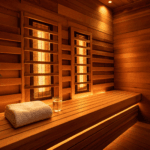
Infrared sauna (50-65°C): Far-infrared light penetrates 1.5-4cm into tissue directly. Air stays cooler but core temperature rises faster than expected. More tolerable for heat-sensitive people.
Get our Supplement Dosing Guide — free.
The exact dosages from published research, compiled into one reference PDF. No fluff, no upsell.
🔒 No spam. Unsubscribe anytime. We send 1-2 emails/month max.
What the Evidence Shows

The strongest cardiovascular data comes from traditional Finnish sauna — the famous Laukkanen et al. (2015) JAMA study tracked 2,315 men for 20 years. 4-7 sauna sessions/week reduced all-cause mortality 40% and sudden cardiac death 63%.
Infrared has smaller studies but promising data on detoxification (sweating heavy metals), pain reduction (chronic pain RCTs), and skin elasticity (collagen production).
Choose Based on Your Goal
- Cardiovascular longevity: Traditional Finnish (the Laukkanen data is hard to beat)
- Joint pain / inflammation: Infrared (deeper tissue penetration)
- Detoxification: Infrared (sweat composition has more lipid-soluble toxins per liter)
- Heat tolerance issues: Infrared (cooler air, longer sessions possible)
- Budget at home: Infrared (single-person units start at $1,500 vs $3,500+ for Finnish)
Optimal Protocol
Traditional sauna: 80-100°C, 15-20 minutes per session, 4-7×/week. Cool-down between rounds (cold shower or plunge). Pair with cold plunge for contrast therapy.
Infrared sauna: 50-65°C, 30-45 minutes per session, 3-5×/week. Hydrate aggressively (lose 0.5-1L per session). Replenish electrolytes — see our magnesium guide.
Safety Considerations
- Pregnancy: traditional sauna NOT recommended; infrared limited time only — consult OB
- Cardiovascular conditions: get clearance, start short sessions
- Hyperthermia symptoms: dizziness, nausea → exit immediately
- Alcohol: never combine with sauna (dehydration + cardiac stress)
Frequently Asked Questions
How often should I sauna for the Laukkanen benefits?
The 4-7×/week frequency drove the 40% mortality reduction. Even 2-3×/week showed 24% reduction.
Can I get sauna benefits in 5 minutes?
Partial. Heat shock protein response begins at 5-10 min. Full cardiovascular adaptation requires 15-20 min sessions.
Best supplements to take with sauna routine?
Magnesium (electrolyte loss), creatine (heat stress recovery), and adequate sodium. Skip the night before if you’re going hard.
Quick Comparison Table
| Feature | Traditional Finnish Sauna | Infrared Sauna |
|---|---|---|
| Temperature | 80-100°C (175-210°F) | 45-65°C (115-150°F) |
| Humidity | 10-20% (löyly = bursts of steam) | Low (dry) |
| Session length | 15-25 min | 30-45 min |
| Sweat onset | 5-7 min | 10-15 min |
| Heat-up time | 30-45 min | 10-15 min |
| Evidence base | Large (Finnish cohorts) | Smaller, growing |
| Cost (home) | $4,000-15,000+ | $1,500-5,000 |
| Power draw | 4-8 kW | 1.5-3 kW |
💡 Prices are approximate and were last reviewed in October 2026. Retailer prices change often — tap a button for the current price on Amazon or iHerb.
How Each Type Works
Traditional sauna
Heats the air to 80-100°C using either electric or wood-fired stones. The high air temperature transfers heat to the body via convection. Pouring water on the stones (löyly) creates short bursts of steam that increase perceived heat dramatically. The classic Finnish experience involves rounds of heat + cooldown + reheat.
Infrared sauna
Uses far-infrared (FIR) heaters to emit radiation that penetrates the skin 1-4 mm and is absorbed by tissue. The air stays cooler (45-65°C) — what heats you is the radiation, not the air. This makes longer sessions tolerable for people who can’t handle traditional sauna temperatures.
Health Effects — Where Each Wins
Cardiovascular
Traditional has the deeper evidence base (Finnish KIHD cohort, 20+ year follow-ups). Infrared has small RCTs showing comparable acute responses (heart rate, blood pressure adaptation) but smaller long-term datasets.
Detoxification (the controversial claim)
Marketing for infrared often emphasizes “deeper detox.” The science: sweat does contain trace heavy metals and some chemicals, but the kidneys and liver do 99% of detoxification work. Sauna of either type produces sweat — the “infrared sweats out more toxins” claim is largely marketing.
Muscle recovery
Both work. Infrared at lower temps may be gentler for daily use; traditional with cold plunge between rounds maximizes the contrast-therapy effect.
Skin
Infrared has some evidence for skin elasticity and collagen support (FIR may stimulate fibroblast activity).
Which Should You Choose?
Choose traditional if:
- You want the largest evidence base
- You enjoy the higher-heat, shorter-duration experience
- You have a dedicated outdoor space or basement for installation
- You want the social/family ritual aspect
Choose infrared if:
- You can’t tolerate traditional sauna heat
- Space and power are limited (apartment, smaller home)
- You want lower upfront cost
- You prefer longer, milder sessions for reading or meditation
Sauna Blankets — A Third Option
Far-infrared sauna blankets ($300-800) are a budget alternative. Effects are real (sweat, heart rate elevation) but the dose is lower than a full cabin. Best used as travel/apartment backup, not a primary modality.
FAQ
Can I use both?
Yes — many enthusiasts alternate based on schedule and tolerance. Heat exposure is heat exposure.
Is infrared dangerous?
Far-infrared is non-ionizing radiation — same wavelength range as the heat radiating from a campfire. No carcinogenic risk.
Head-to-Head: Infrared vs Traditional Sauna (2026 Evidence)
Both saunas deliver cardiovascular benefits, but they’re not interchangeable. Traditional saunas have decades of cardiovascular outcome data (Finnish studies). Infrared has fewer outcome studies but better biomarker data + comfort. Read our methodology.
Sauna Protocols by Goal
Cardiovascular Longevity (Best Evidence)
- Traditional Finnish sauna — 175-195°F
- 20-30 min per session, 4-7x/week (Finnish cohort data)
- Cool-down + hydration between sessions
Detox / Inflammation
- Full-spectrum infrared sauna — 120-150°F
- 30-45 min per session, 3-5x/week
- Lower temp = more sweat at deeper level
Recovery (Post-Workout)
- Either type — 15-20 min
- Wait 30-60 min after intense training (allow HR recovery)
- Hydrate aggressively pre + post
Sauna Comparison Cheatsheet
- Temperature: Traditional 175-195°F vs Infrared 120-150°F
- Time: Traditional 15-25 min vs Infrared 30-45 min
- Cost: Home traditional $4-12k vs Home infrared $2-8k
- Power use: Traditional 6-9kW vs Infrared 1.5-3kW
- Cardiovascular evidence: Traditional has stronger Finnish cohort data
- Comfort: Infrared easier for beginners + heat-sensitive users
Sauna FAQ
Which sauna has better health benefits?
Traditional has more cardiovascular outcome evidence (Finnish studies linking 4+ sessions/week to 40-50% reduced cardiovascular mortality). Infrared has comparable biomarker improvements but less long-term outcome data. Both work — pick based on preference + budget.
Is infrared more “detoxifying”?
Marketing claim. Both saunas induce similar sweat rates and sweat composition. The “detox” benefits are minimal in either type — your liver + kidneys handle 99% of detoxification, not sweat. Both improve circulation, mitochondrial function, and heat shock protein production.
Best home sauna for beginners?
Infrared. Lower temperature (120-150°F) is more comfortable, and many models are smaller (one-person) and plug into a regular outlet. a premium infrared sauna brand, a portable sauna brand, and a portable sauna brand are quality brands. See our infrared sauna guide.
How often should I sauna?
Finnish data: 4+ sessions/week (20+ min) shows strongest cardiovascular benefits. 2-3x/week is decent. 1x/week is minimal effect. Daily is fine for healthy adults.
Sauna + cold plunge combo?
Powerful contrast therapy. Protocol: 15-20 min sauna → 2-3 min cold plunge → repeat 2-3 cycles. Boosts brown fat, mitochondrial biogenesis, and stress resilience. See our cold plunge guide.
Is sauna safe for everyone?
Most healthy adults yes. AVOID if: pregnant, uncontrolled hypertension, recent heart attack, severe kidney disease, or on certain medications (diuretics, beta-blockers). Consult doctor if you have heart conditions.



The recovery gear guides
Compare cold plunge, sauna and red light, reviewed by our team.
- → Best Cold Plunge Tubs 2026
- → Best Cold Plunge Chillers 2026
- → Cold + Sauna Contrast Protocol
- → Best Cold Plunge Cost Guide
- → Best Cold Plunge Under $500
- → Best Infrared Saunas 2026
- → Sauna Blanket vs Sauna
- → Best Sauna Blankets 2026
- → Best Red Light Therapy Devices
- → Red Light Panel vs Mask
- → 7 Cold Plunge Benefits (Science)
- → Sauna Benefits for Longevity
- → Red Light Therapy Benefits
- → Cold Plunge Protocol Tool
- → Sauna Routine Calculator
- → Red Light Dosing Calculator