Affiliate links: as an Amazon Associate and through other programs, we earn from qualifying purchases, at no extra cost to you. Learn more.
Updated 2026
Quick answer: Berberine is a plant alkaloid that lowered blood sugar and blood fats in small trials, most of them run in China, with effects that reviewers describe as modest and studies they rate as limited in quality. It is not a substitute for metformin or any other diabetes medicine: it can interact with several drugs, and the NCCIH says it should not be used in pregnancy, while breastfeeding or in infants.
In This Article
What berberine is

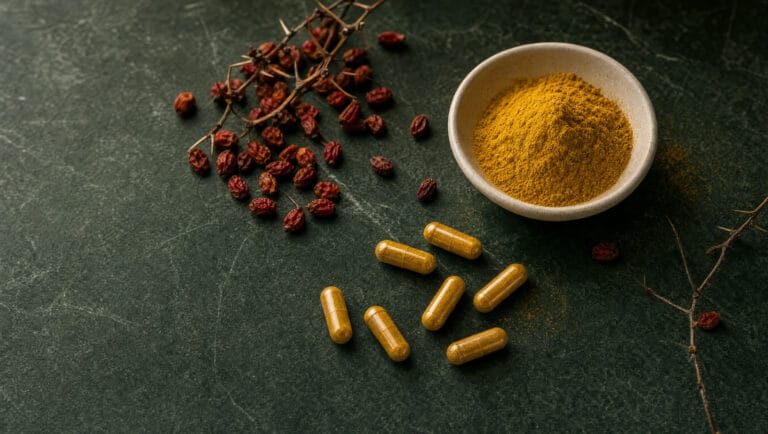
Berberine is a yellow alkaloid found in plants such as goldenseal, barberry, goldthread and Oregon grape (NCCIH). Supplements usually contain berberine hydrochloride (HCl). Very little of an oral dose reaches the bloodstream: in rats, its absolute bioavailability was 0.68% (Chen et al., 2011), and the NCCIH notes that very little berberine may be absorbed from oral goldenseal.
Berberine supplements compared: dose per capsule (2026)
| Product | On the label | Good to know | Buy |
|---|---|---|---|
| Our pick Integrative Therapeutics Berberine | 500 mg berberine HCl per capsule | Trials usually used 500 mg two or three times a day with meals. | See it on Amazon ↗ |
| NOW Berberine Glucose Support | 400 mg berberine HCl per softgel, with MCT oil | A lower dose per softgel. | See it on Amazon ↗ |
| Nutricost Berberine | 1,200 mg berberine HCl per 2 capsules (600 mg each) | Trials split the daily dose across meals. | See it on Amazon ↗ |
Berberine can interact with medicines, including diabetes drugs: ask your doctor or pharmacist first (NCCIH).
Label figures: NIH Dietary Supplement Label Database and the brand listing, checked October 2026. Formulas change, so check the label before you buy. We earn a commission on Amazon purchases at no extra cost to you, and we do not lab-test products.
In animal and cell studies, berberine activates AMPK, an enzyme that senses cellular energy and helps regulate glucose and fat metabolism (Lee et al., 2006). Lab findings like this explain the interest, but they do not show how much a supplement helps a person, so this guide relies on human trials.
Get our free supplement cheat sheet.
One page: typical doses, timing and upper limits for ten well-studied supplements. No upsell.
🔒 No spam. Unsubscribe anytime. We send 1-2 emails/month max.
Berberine vs metformin: what the small trials show
The claim that berberine works as well as metformin comes mainly from a pilot study in China (Yin et al., 2008). Thirty-six adults with newly diagnosed type 2 diabetes took berberine or metformin, 500 mg three times a day, for 13 weeks; 31 were analyzed (15 on berberine, 16 on metformin). These are the average values reported in the full text (Table 2):
| Marker | Berberine (start to end) | Metformin (start to end) |
|---|---|---|
| HbA1c | 9.5% to 7.5% (down 2.0 points) | 9.2% to 7.7% (down 1.4 points) |
| Fasting glucose | 191 to 123 mg/dL | 179 to 129 mg/dL |
| Triglycerides | 100 to 79 mg/dL | 105 to 104 mg/dL |
| Total cholesterol | 170 to 148 mg/dL | 167 to 165 mg/dL |
Two things limit what this can tell you. The groups were small and followed for about three months, and the study was not designed to test whether the two treatments are equal. In a second part of the same paper, 48 people with poorly controlled diabetes added berberine without a control group, and their average HbA1c fell from 8.1% to 7.3%; 20 patients (34.5%) had temporary stomach and bowel side effects.
Larger reviews point the same way, with caveats. A meta-analysis of 27 randomized trials (2,569 people) found that berberine plus lifestyle changes lowered blood sugar more than lifestyle changes alone, and found no statistically significant difference between berberine and oral diabetes drugs, but the authors rated the trials as limited in quality (Lan et al., 2015). An earlier review of 14 trials (1,068 people) reached similar conclusions from low-quality studies (Dong et al., 2012).
Metformin’s record is of a different kind. In the Diabetes Prevention Program, 3,234 adults at high risk were followed for an average of 2.8 years: metformin lowered the rate of new diabetes by 31% and lifestyle changes by 58% compared with placebo (Knowler et al., 2002). In overweight people with type 2 diabetes, metformin lowered diabetes-related deaths by 42% and deaths from any cause by 36% over a median of 10.7 years, compared with a conventional diet-based approach (UKPDS Group, 1998). We found no berberine trial that measured diabetes complications or deaths (PubMed search, October 23, 2026).
The NCCIH stresses that an unproven product should not replace medical treatment for diabetes. If you take metformin or another glucose-lowering medicine, talk to your doctor before adding berberine. For a full side-by-side comparison, see our berberine vs metformin guide.
What the human trials show
An umbrella review of 54 systematic reviews rated most of the evidence on berberine as very low in quality (Shi et al., 2025). With that in mind:
Blood sugar
A 2023 meta-analysis of 20 trials (1,761 people) found that berberine lowered fasting glucose by 0.52 mmol/L (about 9 mg/dL) and HbA1c by 4.48 mmol/mol (about 0.4 percentage points) on average (Zhao et al., 2023). In a pilot trial of 34 people with prediabetes, 500 mg three times a day for 12 weeks lowered average HbA1c from 6.4% to 5.4% compared with placebo (Panigrahi and Mohanty, 2023). The NCCIH summarizes a 2021 review of 46 studies (4,158 participants) as showing possible benefits, mostly in Chinese patients, with wide variability and some studies of poor quality.
Cholesterol and triglycerides
A 2023 meta-analysis of 18 trials (1,788 adults, mostly in China and Hong Kong) found small reductions: LDL cholesterol fell by 0.46 mmol/L (about 18 mg/dL) and triglycerides by 0.34 mmol/L (about 30 mg/dL) (Blais et al., 2023). An earlier review of 11 trials (874 people) reported larger falls, including LDL down 0.65 mmol/L, from trials it rated low in quality (Dong et al., 2013). In a 6-month trial of 337 adults with obesity and fatty liver disease, 1 g a day lowered LDL by 7.7 mg/dL (Lei et al., 2026).
Results also depend on who was studied. In placebo-controlled trials in people with metabolic syndrome, berberine lowered LDL cholesterol by about 0.5 mmol/L (about 19 mg/dL) and triglycerides by about 0.37 mmol/L (about 33 mg/dL), with no effect on HDL cholesterol or blood pressure (Liu et al., 2025). In a review of 41 trials, products with berberine alone lowered triglycerides, but their effect on LDL was not statistically clear (Hernandez et al., 2024).
Body weight
Berberine is often marketed as a natural GLP-1. A 2026 meta-analysis of 23 randomized trials found an average weight loss of 0.88 kg (about 2 lb) and a fall in BMI of 0.48 (Elahi Vahed et al., 2026). In the 6-month trial above, 1 g a day did not reduce visceral or liver fat (Lei et al., 2026). For how these numbers compare with semaglutide and other options, see natural GLP-1 supplements vs the drugs; for doses and products, see our berberine weight loss guide.
PCOS
A 2019 review of 12 randomized trials in women with polycystic ovary syndrome found live birth rates similar to placebo or metformin and lower than with letrozole (Xie et al., 2019). A 2026 reappraisal rated all four eligible trials (452 women) at high risk of compromised integrity and concluded that no reliable conclusions can be drawn (Perera et al., 2026). Do not replace prescribed care without talking to your doctor.
Other uses
In a trial of 1,108 adults in China who had colorectal polyps removed, berberine 0.3 g twice a day lowered the share with new polyps at follow-up colonoscopy from 47% to 36%, with no serious side effects reported (Chen et al., 2020). For small intestinal bacterial overgrowth (SIBO), a non-randomized study found that multi-herb products, some containing berberine, normalized breath tests in 46% of people versus 34% with the antibiotic rifaximin, a difference that was not statistically significant (Chedid et al., 2014).
Doses used in trials
Most trials gave 0.6 to 1.5 g a day, split into two or three doses with meals: 500 mg three times a day in the metformin comparison (Yin et al., 2008), 1 g a day in a 116-person trial in type 2 diabetes with high blood fats (Zhang et al., 2008) and 0.3 g twice a day in the polyp trial (Chen et al., 2020). The NCCIH describes berberine as safe at doses used in clinical situations, 200 to 1,000 mg two to three times daily.
Taking it with meals was the usual approach in trials, and many people start with one dose a day to see how their stomach reacts. We found no trials that tested different dosing schedules or “cycling” berberine on and off (PubMed search, October 23, 2026), so cycling schedules have no human data behind them.
Side effects and drug interactions
Stomach and bowel complaints are the most common: nausea, diarrhea, bloating and constipation (NCCIH). In a review of 18 lipid trials, digestive side effects were reported in 2% to 23% of people taking berberine and 2% to 15% of those on placebo or control, with no serious side effects (Blais et al., 2023).
Interactions matter more. In healthy men, berberine 300 mg three times a day for two weeks reduced the activity of liver enzymes that clear many drugs: CYP2D6 and CYP2C9 activity fell, and exposure to midazolam, a test drug for CYP3A4, rose by about 40% (Guo et al., 2012). In kidney transplant patients, berberine raised blood levels of the immunosuppressant cyclosporine by about 29% (Wu et al., 2005).
- Low blood sugar: the risk is higher with diabetes medicines. A case report describes an athletic man in his 40s who fainted with a blood glucose of 0.9 mmol/L (about 16 mg/dL) after taking berberine as a performance supplement (Henshall et al., 2025).
- Metformin: goldenseal, which contains berberine, lowered metformin exposure in healthy volunteers (Nguyen et al., 2021); in people with type 2 diabetes taking metformin, the overall interaction was not clinically meaningful (Nguyen et al., 2025). Your doctor should still know.
- Other prescription medicines: ask your doctor or pharmacist before using berberine, especially with drugs such as cyclosporine whose blood levels must stay in a narrow range.
- Pregnancy, breastfeeding and infants: do not use it. Berberine has been linked to a harmful buildup of bilirubin in infants, which can cause brain damage (NCCIH).
How to read a berberine label
Check the amount of berberine HCl per capsule and how many capsules make a serving; most trials used about 500 mg per dose. Products sold as goldenseal or barberry do not tell you how much berberine you get, and the NCCIH notes that some goldenseal products have contained herbs or ingredients not listed on the label.
Dihydroberberine is sold as a better-absorbed form. In a crossover study of five men funded by a manufacturer, it produced higher blood levels of berberine than berberine HCl but no difference in glucose or insulin (Moon et al., 2021). We found no longer human trials of it (PubMed search, October 23, 2026).
Combination products
Many products add chromium, cinnamon or alpha-lipoic acid. According to the NCCIH, a review of 16 studies (868 participants) suggested chromium may help HbA1c and fasting glucose in type 2 diabetes, a review of 16 studies (1,098 participants) found cinnamon helped fasting glucose but the studies differed widely, and alpha-lipoic acid did no better than placebo on blood sugar in a review of 10 studies. Cassia cinnamon contains coumarin, which might worsen liver disease.
Combination trials cannot show which ingredient did what. In 12-week trials, berberine with cinnamon lowered fasting glucose, HbA1c and LDL in people with type 2 diabetes (Mansour et al., 2025), and berberine with white mulberry leaf and chromium reduced body fat by 2.35 kg more than placebo in 93 adults, though the authors say each ingredient’s contribution remains undetermined (Xenos et al., 2026).
The bottom line
Berberine has small, mostly short trials showing modest falls in blood sugar, LDL cholesterol and body weight, from studies that reviewers rate as limited or low in quality. It is not a replacement for metformin, whose benefits on complications and survival come from long trials that berberine has never had.
If you want to try it, talk to your doctor first, especially if you take any prescription medicine, start with one dose a day with a meal, and do not use it during pregnancy or breastfeeding.
Berberine has real but limited evidence for blood sugar: pooled trials, most of them small and short, show modest drops in fasting glucose and HbA1c. It is not a substitute for metformin or any prescribed treatment. Stomach side effects are common at higher doses and safety data beyond about a year are limited. If you take diabetes medication, talk to your doctor before trying it.
Scientific References
- Chen et al., 2011. Bioavailability study of berberine and the enhancing effects of TPGS on intestinal absorption in rats. AAPS PharmSciTech.
- Lee et al., 2006. Berberine, a natural plant product, activates AMP-activated protein kinase with beneficial metabolic effects in diabetic and insulin-resistant states. Diabetes.
- Yin et al., 2008. Efficacy of berberine in patients with type 2 diabetes mellitus. Metabolism.
- Lan et al., 2015. Meta-analysis of the effect and safety of berberine in the treatment of type 2 diabetes mellitus, hyperlipemia and hypertension. J Ethnopharmacol.
- Dong et al., 2012. Berberine in the treatment of type 2 diabetes mellitus: a systemic review and meta-analysis. Evid Based Complement Alternat Med.
- Knowler et al., 2002. Reduction in the incidence of type 2 diabetes with lifestyle intervention or metformin. N Engl J Med.
- UKPDS Group, 1998. Effect of intensive blood-glucose control with metformin on complications in overweight patients with type 2 diabetes (UKPDS 34). UK Prospective Diabetes Study (UKPDS) Group. Lancet.
- Shi et al., 2025. Berberine and health outcomes: an overview of systematic reviews. BMC Complement Med Ther.
- Zhao et al., 2023. Overall and Sex-Specific Effect of Berberine on Glycemic and Insulin-Related Traits: a Systematic Review and Meta-Analysis of Randomized Controlled Trials. J Nutr.
- Panigrahi and Mohanty, 2023. Efficacy and safety of HIMABERB® Berberine on glycemic control in patients with prediabetes: double-blind, placebo-controlled, and randomized pilot trial. BMC Endocr Disord.
- Blais et al., 2023. Overall and Sex-Specific Effect of Berberine for the Treatment of Dyslipidemia in Adults: A Systematic Review and Meta-Analysis of Randomized Placebo-Controlled Trials. Drugs.
- Dong et al., 2013. The effects of berberine on blood lipids: a systemic review and meta-analysis of randomized controlled trials. Planta Med.
- Lei et al., 2026. Berberine and Adiposity in Diabetes-Free Individuals With Obesity and MASLD: A Randomized Clinical Trial. JAMA Netw Open.
- Elahi Vahed et al., 2026. The effect of berberine on obesity indices: a systematic review and meta-analysis. Int J Obes (Lond).
- Xie et al., 2019. The Effect of Berberine on Reproduction and Metabolism in Women with Polycystic Ovary Syndrome: A Systematic Review and Meta-Analysis of Randomized Control Trials. Evid Based Complement Alternat Med.
- Perera et al., 2026. Questionable Evidence for Berberine in Polyendocrine Metabolic Ovarian Syndrome: An Integrity-Based Reappraisal. Adv Ther.
- Chen et al., 2020. Berberine versus placebo for the prevention of recurrence of colorectal adenoma: a multicentre, double-blinded, randomised controlled study. Lancet Gastroenterol Hepatol.
- Chedid et al., 2014. Herbal therapy is equivalent to rifaximin for the treatment of small intestinal bacterial overgrowth. Glob Adv Health Med.
- Zhang et al., 2008. Treatment of type 2 diabetes and dyslipidemia with the natural plant alkaloid berberine. J Clin Endocrinol Metab.
- Guo et al., 2012. Repeated administration of berberine inhibits cytochromes P450 in humans. Eur J Clin Pharmacol.
- Wu et al., 2005. Effects of berberine on the blood concentration of cyclosporin A in renal transplanted recipients: clinical and pharmacokinetic study. Eur J Clin Pharmacol.
- Henshall et al., 2025. Berberine-induced hypoglycaemia and electrocardiogram interpretation in athletes. BMJ Case Rep.
- Nguyen et al., 2021. Assessing Transporter-Mediated Natural Product-Drug Interactions Via In vitro-In Vivo Extrapolation: Clinical Evaluation With a Probe Cocktail. Clin Pharmacol Ther.
- Nguyen et al., 2025. The Pharmacokinetic Interaction Between Metformin and the Natural Product Goldenseal Is Metformin Dose-Dependent: A Three-Arm Crossover Study in Adults With Type 2 Diabetes. Clin Transl Sci.
- Moon et al., 2021. Absorption Kinetics of Berberine and Dihydroberberine and Their Impact on Glycemia: A Randomized, Controlled, Crossover Pilot Trial. Nutrients.
- Mansour et al., 2025. The efficacy and safety of berberine in combination with cinnamon supplementation in patients with type 2 diabetes: a randomized clinical trial. Eur J Nutr.
- Xenos et al., 2026. Effects of Berberine, White Mulberry Leaf Extract and Chromium Picolinate on Body Composition and Insulin Resistance in Adults with Obesity: A Randomized Controlled Trial. Nutrients.
- National Center for Complementary and Integrative Health (NCCIH): Diabetes and Dietary Supplements: What You Need To Know (updated November 2023).
- National Center for Complementary and Integrative Health (NCCIH): Goldenseal (updated February 2025).