Affiliate links: as an Amazon Associate and through other programs, we earn from qualifying purchases, at no extra cost to you. Learn more.
Quick answer: Metformin is the first-line medicine for type 2 diabetes, backed by trials that followed thousands of people for years; berberine is a supplement with small, mostly short trials. In a 3-month pilot study of 31 analyzed adults, berberine lowered HbA1c by 2.0 points and metformin by 1.4, but the study was not designed to show that they are equal. Do not swap or combine them without your doctor.
In This Article
⚠️ This article is educational and not medical advice. Never start, stop, or modify prescription medications without your doctor’s supervision.
Berberine is often promoted online as a natural alternative to diabetes drugs. A few small trials have compared it directly with metformin, the most prescribed medicine for type 2 diabetes (Bailey, 2017). Here is what those trials found, where berberine falls short, and why the two are not interchangeable.
Berberine supplements compared: dose per capsule (2026)
| Product | On the label | Good to know | Buy |
|---|---|---|---|
| Our pick Integrative Therapeutics Berberine | 500 mg berberine HCl per capsule | Trials usually used 500 mg two or three times a day with meals. | See it on Amazon ↗ |
| NOW Berberine Glucose Support | 400 mg berberine HCl per softgel, with MCT oil | A lower dose per softgel. | See it on Amazon ↗ |
| Nutricost Berberine | 1,200 mg berberine HCl per 2 capsules (600 mg each) | Trials split the daily dose across meals. | See it on Amazon ↗ |
Berberine can interact with medicines, including diabetes drugs: ask your doctor or pharmacist first (NCCIH).
Label figures: NIH Dietary Supplement Label Database and the brand listing, checked October 2026. Formulas change, so check the label before you buy. We earn a commission on Amazon purchases at no extra cost to you, and we do not lab-test products.
This guide compares the two on blood sugar, cholesterol, side effects and safety, using the trials and official sources linked in each section. Independent recommendations. Affiliate disclosure.
Get our free supplement cheat sheet.
One page: typical doses, timing and upper limits for ten well-studied supplements. No upsell.
🔒 No spam. Unsubscribe anytime. We send 1-2 emails/month max.
Quick verdict: the honest answer
- Diagnosed type 2 diabetes: metformin, as your doctor prescribes it. A 10-year trial in overweight patients found fewer diabetes-related deaths than with a diet-based approach.
- Prediabetes: lifestyle changes first; metformin is the option with long-term data on lowering the risk of diabetes. Berberine has only small, short trials.
- Stomach upset on metformin: ask about a slower dose increase, taking it with meals or an extended-release tablet. Berberine also causes stomach side effects.
- High LDL cholesterol: berberine’s average effect in a 2023 review was small, about 18 mg/dL. Talk to your doctor about tested options.
- Taking other medicines: do not add berberine on your own; it changes how the body clears several drugs.
- Pregnant or breastfeeding: avoid berberine.
Sources for this summary: the trials in the sections below, the Diabetes Prevention Program (Knowler et al., 2002), the UKPDS (UKPDS Group, 1998), a review of metformin stomach side effects (Bonnet and Scheen, 2017), a 2023 meta-analysis of berberine and cholesterol (Blais et al., 2023) and the NCCIH.
What berberine is
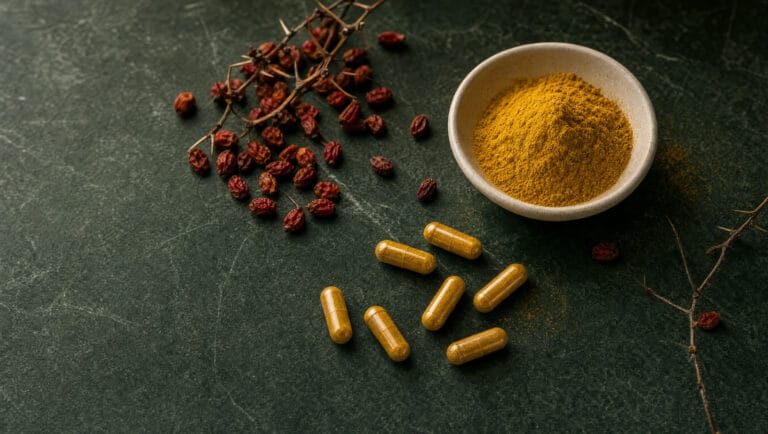
Berberine is a yellow alkaloid found in plants such as barberry, goldenseal, goldthread and Oregon grape (NCCIH). In animal and cell studies it activates AMPK, an enzyme that senses cellular energy (Lee et al., 2006), and very little of an oral dose is absorbed: in rats, absolute bioavailability was 0.68% (Chen et al., 2011).
Supplements usually list berberine HCl per capsule, often 400 to 500 mg; check how many capsules make a serving. Trials typically used 500 mg two or three times a day with meals.
What metformin is
Metformin is a biguanide medicine derived from goat’s rue (Galega officinalis). It has been used since 1957, was approved in the United States in 1995 and is the most prescribed medicine for type 2 diabetes (Bailey, 2017).
It lowers the amount of glucose absorbed from food and the amount made by the liver, and it increases the body’s response to insulin. Regular tablets are usually taken with meals two or three times a day; extended-release tablets once daily with the evening meal (MedlinePlus).
Head-to-head efficacy: what the trials show
The most cited comparison is a pilot study from China (Yin et al., 2008): 36 adults with newly diagnosed type 2 diabetes took berberine or metformin, 500 mg three times a day, for 13 weeks, and 31 were analyzed. These are the average values reported in the full text (Table 2):
| Marker | Berberine (start to end) | Metformin (start to end) |
|---|---|---|
| HbA1c | 9.5% to 7.5% (down 2.0 points) | 9.2% to 7.7% (down 1.4 points) |
| Fasting glucose | 191 to 123 mg/dL | 179 to 129 mg/dL |
| Triglycerides | 100 to 79 mg/dL | 105 to 104 mg/dL |
| Total cholesterol | 170 to 148 mg/dL | 167 to 165 mg/dL |
On HbA1c, berberine’s fall was 2.0 points against 1.4 for metformin, but the study was small, short and not designed to test whether the two are equal. The LDL figure of about 25% that circulates online comes from a different trial of 32 people over 3 months (Kong et al., 2004); a 2023 meta-analysis of 18 trials found a smaller average fall in LDL of about 18 mg/dL (Blais et al., 2023).
A 2015 meta-analysis of 27 trials (2,569 people) found no statistically significant difference between berberine and oral diabetes drugs for blood sugar, but the authors cautioned that the trials were of limited quality (Lan et al., 2015).
The honest interpretation: berberine lowers blood sugar modestly in short trials, mostly in Chinese patients. Metformin has what berberine lacks: long trials on hard outcomes. In the Diabetes Prevention Program, metformin lowered the rate of new diabetes by 31% over about 2.8 years (Knowler et al., 2002), and in overweight people with type 2 diabetes it lowered diabetes-related deaths by 42% over a median of 10.7 years (UKPDS Group, 1998).
Side effects: where they differ
Metformin’s common side effects (MedlinePlus):
- Diarrhea, nausea, stomach discomfort, gas, indigestion or constipation; a slow dose increase, taking it with meals and extended-release tablets can help (Bonnet and Scheen, 2017).
- A rare but serious risk of lactic acidosis: tell your doctor if you have kidney disease, are over 65, or have had a heart attack, stroke, or heart or liver disease.
- Lower vitamin B12 over time: in the Diabetes Prevention Program Outcomes Study, low B12 was found in 4.3% of metformin users versus 2.3% on placebo at 5 years (Aroda et al., 2016). See our B12 guide.
Berberine’s common side effects:
- Nausea, diarrhea, bloating and constipation (NCCIH); in lipid trials, digestive side effects affected 2% to 23% of people on berberine and 2% to 15% on control (Blais et al., 2023).
- Drug interactions: in healthy men, berberine reduced the activity of the liver enzymes CYP2D6, CYP2C9 and CYP3A4 (Guo et al., 2012), and in kidney transplant patients it raised cyclosporine levels by about 29% (Wu et al., 2005).
- Not for use in pregnancy, while breastfeeding or in infants (NCCIH).
Interaction warning: if you take any prescription medicine, ask your doctor or pharmacist before starting berberine.
Who should use what: a decision framework
Metformin is the usual choice if
- You have type 2 diabetes; an HbA1c of 6.5% or higher is in the diabetes range (NIDDK).
- You have prediabetes (HbA1c 5.7% to 6.4%) and your doctor recommends it alongside lifestyle changes.
- You want a medicine with decades of safety monitoring.
Berberine is an option to discuss with your doctor if
- You do not have diabetes, take no medicines that could interact, and accept that the trials are small and short.
- You plan a follow-up blood test after about 3 months to see whether anything changed.
Avoid both without a specialist if
- You are pregnant or breastfeeding (berberine).
- You have kidney disease (metformin).
- You take cyclosporine or other drugs whose blood levels must stay in a narrow range (berberine).
- You have type 1 diabetes (neither replaces insulin).
Dosing
Berberine: trials used 500 mg two or three times a day with meals (Yin et al., 2008; Zhang et al., 2008). The NCCIH describes doses of 200 to 1,000 mg two to three times daily as safe in clinical situations. Many people start with one dose a day to see how their stomach reacts.
Metformin: your doctor sets the dose. It is usually started low and raised gradually, not more often than every 1 to 2 weeks (MedlinePlus).
Both: HbA1c reflects your average blood sugar over about 3 months, so allow about that long before judging a change (NIDDK).
Five berberine supplements compared (2026)
We have not tested these products ourselves. The notes below come from their labels and our other berberine guides; check the current label, the dose per capsule and the serving size before you buy.
Thorne Berberine
500 mg of berberine HCl per capsule, from Indian barberry (Berberis aristata).
Integrative Therapeutics Berberine
500 mg of berberine HCl per capsule (label). Trials usually used 500 mg two or three times a day with meals.
👉 Amazon
NOW Foods Berberine Glucose Support
Our weight loss guide lists the current version at 400 mg of berberine HCl per softgel with MCT oil, less per unit than the 500 mg used in most trials. Labels have changed over time, so check the one you buy.
Designs for Health Berberine Synergy
Sold as a combination formula. We could not check the current label for this guide, so confirm the berberine dose per serving and the other ingredients; the trials above tested berberine on its own.
👉 Amazon
Pure Encapsulations Berberine UltraPure
We could not check the current label for this guide; confirm the berberine dose per capsule before you buy.
👉 Amazon
Taking berberine and metformin together
Only under your doctor’s supervision. In trials, adding berberine to oral diabetes drugs lowered blood sugar more than the drugs alone, but the trials were of limited quality (Lan et al., 2015). Combining glucose-lowering products can push blood sugar further down, so it needs monitoring.
Berberine-containing herbs may also change metformin levels. In healthy volunteers, goldenseal lowered metformin exposure by about a quarter (Nguyen et al., 2021; NCCIH). In people with type 2 diabetes already taking metformin, the overall interaction was not clinically meaningful, although exposure fell by about 20% in those on low metformin doses (Nguyen et al., 2025).
If you take metformin and want to try berberine, discuss it with your doctor first and check your blood sugar as advised.
Last updated: October 2026. Corrected the 2008 trial figures (metformin lowered HbA1c by 1.4 points), removed unsupported claims about LDL and product purity, added drug-interaction and pregnancy warnings, and linked each figure to its source.
Scientific References
- Bailey, 2017. Metformin: historical overview. Diabetologia.
- Knowler et al., 2002. Reduction in the incidence of type 2 diabetes with lifestyle intervention or metformin. N Engl J Med.
- UKPDS Group, 1998. Effect of intensive blood-glucose control with metformin on complications in overweight patients with type 2 diabetes (UKPDS 34). UK Prospective Diabetes Study (UKPDS) Group. Lancet.
- Bonnet and Scheen, 2017. Understanding and overcoming metformin gastrointestinal intolerance. Diabetes Obes Metab.
- Blais et al., 2023. Overall and Sex-Specific Effect of Berberine for the Treatment of Dyslipidemia in Adults: A Systematic Review and Meta-Analysis of Randomized Placebo-Controlled Trials. Drugs.
- Lee et al., 2006. Berberine, a natural plant product, activates AMP-activated protein kinase with beneficial metabolic effects in diabetic and insulin-resistant states. Diabetes.
- Chen et al., 2011. Bioavailability study of berberine and the enhancing effects of TPGS on intestinal absorption in rats. AAPS PharmSciTech.
- Yin et al., 2008. Efficacy of berberine in patients with type 2 diabetes mellitus. Metabolism.
- Kong et al., 2004. Berberine is a novel cholesterol-lowering drug working through a unique mechanism distinct from statins. Nat Med.
- Lan et al., 2015. Meta-analysis of the effect and safety of berberine in the treatment of type 2 diabetes mellitus, hyperlipemia and hypertension. J Ethnopharmacol.
- Aroda et al., 2016. Long-term Metformin Use and Vitamin B12 Deficiency in the Diabetes Prevention Program Outcomes Study. J Clin Endocrinol Metab.
- Guo et al., 2012. Repeated administration of berberine inhibits cytochromes P450 in humans. Eur J Clin Pharmacol.
- Wu et al., 2005. Effects of berberine on the blood concentration of cyclosporin A in renal transplanted recipients: clinical and pharmacokinetic study. Eur J Clin Pharmacol.
- Zhang et al., 2008. Treatment of type 2 diabetes and dyslipidemia with the natural plant alkaloid berberine. J Clin Endocrinol Metab.
- Nguyen et al., 2021. Assessing Transporter-Mediated Natural Product-Drug Interactions Via In vitro-In Vivo Extrapolation: Clinical Evaluation With a Probe Cocktail. Clin Pharmacol Ther.
- Nguyen et al., 2025. The Pharmacokinetic Interaction Between Metformin and the Natural Product Goldenseal Is Metformin Dose-Dependent: A Three-Arm Crossover Study in Adults With Type 2 Diabetes. Clin Transl Sci.
- National Center for Complementary and Integrative Health (NCCIH): Diabetes and Dietary Supplements: What You Need To Know (updated November 2023).
- MedlinePlus (National Library of Medicine): Metformin (updated February 15, 2024).
- National Institute of Diabetes and Digestive and Kidney Diseases (NIDDK): Diabetes Tests and Diagnosis (updated July 2022).
- National Center for Complementary and Integrative Health (NCCIH): Goldenseal (updated February 2025).