Affiliate links: as an Amazon Associate and through other programs, we earn from qualifying purchases, at no extra cost to you. Learn more.
Updated 2026
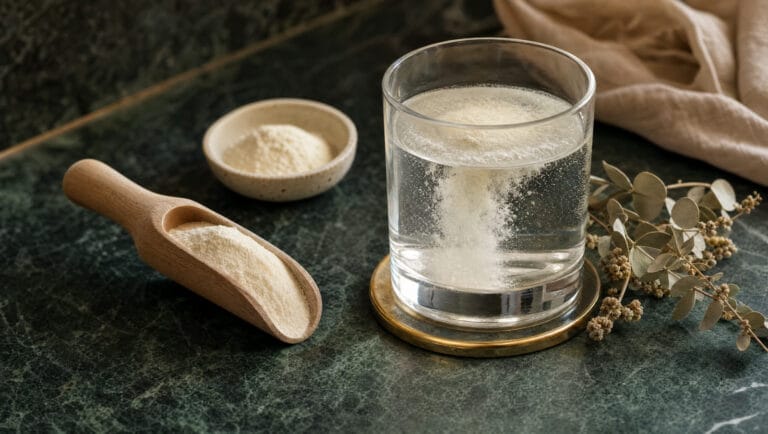

Collagen supplements come in two main kinds. Hydrolyzed collagen, sold as collagen peptides, was used at 2.5 to 10 g a day in the skin trials (Choi et al., 2019) and at 10 g a day in a joint-pain trial (Clark et al., 2008). Undenatured type II collagen, made from chicken breastbone cartilage, is taken at just 40 mg a day and was tested for knee osteoarthritis (Lugo et al., 2016). Here is what each kind did in trials, including where it did nothing.
In This Article
What the Trials Found

Skin: small gains, mostly in company-funded studies
In 69 women aged 35 to 55, 2.5 g or 5 g of collagen peptides a day for 8 weeks improved skin elasticity compared with placebo, while skin moisture did not change significantly (Proksch et al., 2014). A 2021 meta-analysis of 19 trials with 1,125 participants, 95% of them women, found better skin hydration, elasticity and wrinkles (de Miranda et al., 2021).
Collagen peptides compared: grams per serving (2026)
| Product | On the label | Good to know | Buy |
|---|---|---|---|
| Our pick Vital Proteins Collagen Peptides | 20 g bovine collagen peptides per 2 scoops | Unflavored. Skin studies used 2.5 to 10 g a day. | See it on Amazon ↗ |
| Sports Research Collagen Peptides | 11 g hydrolyzed bovine collagen per scoop | One scoop covers the 2.5 to 10 g used in studies. | See it on Amazon ↗ |
| Great Lakes Wellness Collagen Peptides | 20 g bovine collagen peptides per serving (18 g protein) | Collagen lacks some essential amino acids, so do not count it as complete protein. | See it on Amazon ↗ |
| Orgain Collagen Peptides | 20 g bovine collagen peptides per 2 scoops | Also sold mixed with other ingredients: choose the plain version if you only want collagen. | See it on Amazon ↗ |
Label figures: NIH Dietary Supplement Label Database and the brand listing, checked October 2026. Formulas change, so check the label before you buy. We earn a commission on Amazon purchases at no extra cost to you, and we do not lab-test products.
A 2025 meta-analysis of 23 trials with 1,474 participants looked closer. The overall result was positive, but trials that were not funded by companies found no effect on hydration, elasticity or wrinkles, and neither did the high-quality trials. The authors concluded that there is no clinical evidence to support using collagen supplements against skin aging (Myung and Park, 2025).
Get our free supplement cheat sheet.
One page: typical doses, timing and upper limits for ten well-studied supplements. No upsell.
🔒 No spam. Unsubscribe anytime. We send 1-2 emails/month max.
Joints: some benefit for pain
In 147 college athletes with activity-related joint pain, 10 g of collagen hydrolysate a day for 24 weeks reduced pain when walking, standing, resting, carrying and lifting compared with placebo, in the 97 people who could be analyzed (Clark et al., 2008). In osteoarthritis, a meta-analysis found that collagen lowered total symptom scores and pain on a visual scale, but the pain and function subscores of the main questionnaire did not differ from placebo (García-Coronado et al., 2019).
In 191 adults with knee osteoarthritis, 40 mg of undenatured type II collagen a day for 180 days improved symptom scores more than placebo and more than glucosamine with chondroitin. Two of the three authors were employees of a supplement company (Lugo et al., 2016).
Bones: one trial
In 131 postmenopausal women with low bone density, 5 g of collagen peptides a day for 12 months slightly raised bone density at the spine and hip compared with placebo; 102 women completed the study (König et al., 2018).
Nails: one small study without placebo
In 25 people with brittle nails, 2.5 g of collagen peptides a day for 24 weeks was followed by 12% faster nail growth and 42% fewer broken nails. Everyone took the supplement and there was no placebo group, so the result is weak evidence (Hexsel et al., 2017).
Hair: no good evidence
A 2019 systematic review of 11 randomized collagen trials in dermatology (805 people) covered skin aging, dry skin, cellulite and pressure ulcers, but none of the trials studied hair (Choi et al., 2019). We found no placebo-controlled trial showing that collagen supplements improve hair.
Collagen by Goal
| Goal | Type and daily dose in trials | Length | What happened |
|---|---|---|---|
| Skin elasticity | Hydrolyzed collagen, 2.5 to 10 g | About 8 weeks or longer | Small gains overall; no effect in independent or high-quality trials |
| Activity-related joint pain | Hydrolyzed collagen, 10 g | 24 weeks | Less pain in athletes |
| Knee osteoarthritis | Undenatured type II collagen, 40 mg | 180 days | Better symptom scores in one industry-run trial |
| Bone density | Hydrolyzed collagen, 5 g | 12 months | Small rise in one trial |
| Nails | Hydrolyzed collagen, 2.5 g | 24 weeks | Faster growth in a study without placebo |
| Hair | No placebo-controlled trials found | Not studied | Unknown |
Every figure in this table comes from the studies linked in the section above.
Vitamin C, Timing and Protein
Your body needs vitamin C to make collagen, but most people in the United States already get enough from food. Adults need 90 mg a day (men) or 75 mg (women), and people who smoke need 35 mg more (NIH Office of Dietary Supplements). A collagen product does not need added vitamin C for most people.
In the skin trials, the dose was simply taken once a day (Proksch et al., 2014). The only timing study gave 8 healthy men 15 g of vitamin C-enriched gelatin 1 hour before 6 minutes of rope skipping, which doubled a blood marker of collagen production. It used gelatin rather than collagen peptides and did not measure joints or injuries (Shaw et al., 2017).
How to Choose a Collagen Product
- Match the type to your goal. Collagen peptides at 2.5 to 10 g a day were used for skin (Choi et al., 2019) and 10 g a day for joint pain in athletes (Clark et al., 2008). Undenatured type II collagen is a different product taken at 40 mg a day (Lugo et al., 2016); the doses are not interchangeable.
- Check the grams of collagen per serving against those trial doses, so you know how much one scoop gives you.
- Bovine or marine: we found no trials comparing them head to head, so choose based on diet, allergies and price.
- Skip the extras you do not need. Added vitamin C is unnecessary for most people (NIH Office of Dietary Supplements).
- Look for an independent testing seal. Certification programs such as NSF Certified for Sport check that products contain the labeled amounts and are free of many banned substances (NIH Office of Dietary Supplements).
Safety and Side Effects
Collagen has a good safety record in trials. No side effects were noted in the 8-week skin trial (Proksch et al., 2014), a review of 11 randomized trials found no reported adverse events (Choi et al., 2019), and in the 180-day trial of undenatured type II collagen, safety results were similar to placebo (Lugo et al., 2016).
- Check the animal source on the label, for example bovine, marine or chicken, if you have a food allergy or follow dietary rules.
- Collagen adds protein. If your doctor has told you to limit protein, for example because of kidney disease, ask before using it.
- If you take vitamin C on top of collagen, stay under the adult upper limit of 2,000 mg a day (NIH Office of Dietary Supplements).
The Bottom Line on Collagen Supplements
Collagen peptides have small trials showing modest gains in skin elasticity at 2.5-10 g a day after about 8 weeks, and 10 g a day eased activity-related joint pain in athletes after 24 weeks. Evidence for hair is weak. Most people get enough vitamin C from food, and there is no good evidence that marine collagen beats bovine.
Collagen peptides at 2.5 to 10 g a day gave small improvements in skin elasticity in trials, but independent and high-quality trials found no effect (Myung and Park, 2025). The best joint data are 10 g a day for activity-related pain in athletes (Clark et al., 2008) and 40 mg of undenatured type II collagen for knee osteoarthritis in an industry-run trial (Lugo et al., 2016). Evidence for nails comes from one study without placebo (Hexsel et al., 2017), and we found none for hair.
- Choose by goal: collagen peptides for skin or joint pain, undenatured type II collagen for knee osteoarthritis.
- Give it the time used in the trials: about 8 weeks for skin and up to 24 weeks for joints.
- Most people do not need added vitamin C.




- 1Proksch E, et al. (2014). Oral supplementation of specific collagen peptides has beneficial effects on human skin physiology. Skin Pharmacol Physiol. PMID 23949208
- 2Zdzieblik D, et al. (2017). Improvement of activity-related knee joint discomfort following supplementation of specific collagen peptides. Appl Physiol Nutr Metab. PMID 28177710
- 3Hexsel D, et al. (2017). Oral supplementation with specific bioactive collagen peptides improves nail growth. J Cosmet Dermatol. PMID 28786550
- 4Shaw G, et al. (2017). Vitamin C-enriched gelatin supplementation before intermittent activity augments collagen synthesis. Am J Clin Nutr. PMID 27852613
All studies are peer-reviewed and sourced from PubMed/NCBI. This article is for informational purposes only and does not constitute medical advice. Consult a qualified healthcare provider before starting any supplement regimen.
Related supplement guides
Evidence-ranked picks for the supplements that actually matter.