Affiliate links: as an Amazon Associate and through other programs, we earn from qualifying purchases, at no extra cost to you. Learn more.
Quick answer: Curcumin, the main active compound in turmeric, eased knee osteoarthritis pain about as much as ibuprofen in one 4-week trial and lowered blood inflammation markers by small amounts in a meta-analysis, but very little of it is absorbed unless it is taken with piperine or in a special formulation. Those high-absorption products have been linked to liver damage in some people (NCCIH), so check with your doctor if you have liver disease, take medicines or are pregnant.
In This Article
This review covers what curcumin does in people: how well it is absorbed, what the trials found for joint pain, gut inflammation, inflammation markers and mood, the doses used, and the safety issues that matter most, especially for the liver. For other options, see our guide to anti-inflammatory supplements.
- Very little curcumin reaches the blood on its own: in one study, 2 g gave undetectable or very low levels (Shoba et al., 1998).
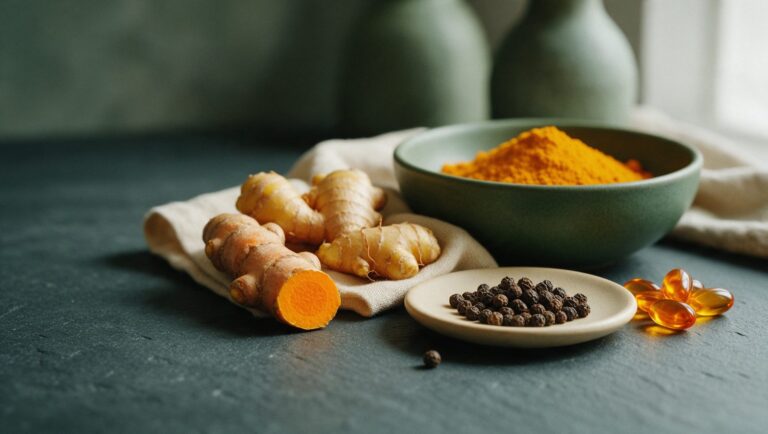
- With 20 mg of piperine from black pepper, its bioavailability rose by 2,000% in the same study.
- In 367 people with knee osteoarthritis, 1,500 mg a day of turmeric extract was as effective as 1,200 mg of ibuprofen over 4 weeks, with fewer reports of stomach pain (Kuptniratsaikul et al., 2014).
- Liver damage has been reported with high-absorption products: stop and see a doctor if you notice fatigue, nausea, poor appetite, dark urine or jaundice (NCCIH).
How curcumin is thought to work
Curcumin makes up a small share of turmeric root powder: in one analysis, turmeric powders averaged 3.14% curcumin by weight (Tayyem et al., 2006). In lab studies curcumin has anti-inflammatory and antioxidant effects (Anand et al., 2007); such findings explain the interest, but they do not show how much a capsule helps a person.
Get our free supplement cheat sheet.
One page: typical doses, timing and upper limits for ten well-studied supplements. No upsell.
🔒 No spam. Unsubscribe anytime. We send 1-2 emails/month max.
Absorption: the main problem
Curcumin is poorly absorbed, quickly metabolized and quickly eliminated (Anand et al., 2007). In rats, its oral bioavailability was about 1% (Yang et al., 2007); in people, single doses of 500 to 8,000 mg left no measurable curcumin in the blood, and only low levels appeared at 10,000 to 12,000 mg (Lao et al., 2006).
- Piperine: 20 mg taken with 2 g of curcumin raised its bioavailability by 2,000% in healthy volunteers (Shoba et al., 1998).
- Lecithin (phospholipid) formulations: total curcuminoid absorption was about 29 times higher than with a standard extract, but blood levels were still far below those needed for most anti-inflammatory effects seen in the lab (Cuomo et al., 2011).
- Other technologies: liposomes, nanoparticles and related approaches are being studied (Anand et al., 2007).
Higher absorption cuts both ways: the NCCIH notes that liver damage has been reported in some people who took curcumin products made to increase bioavailability.
What the trials found
Knee osteoarthritis and joint pain
In 367 people with knee osteoarthritis, 1,500 mg a day of turmeric extract was not inferior to 1,200 mg of ibuprofen on pain and function after 4 weeks, with fewer reports of abdominal pain (Kuptniratsaikul et al., 2014). A meta-analysis of 15 trials (1,670 people) found curcuminoids lowered pain scores compared with placebo and were not inferior to NSAIDs, but the studies were of low quality and varied widely (Feng et al., 2022). An earlier review of 8 trials, using about 1,000 mg of curcumin a day, judged the number and quality of trials not sufficient for definitive conclusions (Daily et al., 2016).
Ulcerative colitis and Crohn’s disease
In 89 people with ulcerative colitis in remission who also took standard drugs (sulfasalazine or mesalamine), curcumin 1 g twice a day for 6 months was followed by fewer relapses than placebo, 4.65% versus 20.51% (Hanai et al., 2006). A Cochrane review of that trial judged the 6-month difference not statistically significant (P = 0.06) and found no difference at 12 months (Kumar et al., 2012). In Crohn’s disease after bowel surgery, 3 g a day for 6 months did not lower recurrence (58% versus 68%), and severe recurrence was more common with curcumin, 55% versus 26% (Bommelaer et al., 2020).
Inflammation markers
A meta-analysis of 32 trials (2,038 participants) found that curcumin lowered C-reactive protein by 1.55 mg/L, interleukin-6 by 1.69 pg/mL and TNF-alpha by 3.13 pg/mL on average; the authors call for studies to confirm the best dose, duration and formulation (Ferguson et al., 2021).
Depression
A meta-analysis of 6 small clinical trials in major depression found a small average reduction in symptoms with curcumin (standardized mean difference -0.34) (Al-Karawi et al., 2016). That is not enough to replace standard care; talk to your doctor before changing any treatment.
Doses used in trials
| Use | Dose in the trial | Duration | Result |
|---|---|---|---|
| Knee osteoarthritis | 1,500 mg a day of turmeric extract | 4 weeks | Not inferior to ibuprofen (Kuptniratsaikul et al., 2014) |
| Arthritis (review) | About 1,000 mg a day of curcumin | Varied | Promising, not definitive (Daily et al., 2016) |
| Ulcerative colitis, with standard drugs | 1 g twice a day | 6 months | Fewer relapses; not significant in a Cochrane review (Kumar et al., 2012) |
| Crohn’s disease after surgery | 3 g a day | 6 months | No benefit (Bommelaer et al., 2020) |
The NCCIH says conventionally formulated turmeric or curcumin (not modified to increase absorption) is likely safe in recommended amounts for up to 2 or 3 months. Taking curcumin with a meal that contains fat is common advice, but the trials above did not compare it with taking it on an empty stomach.
Side effects and liver safety
Oral turmeric can cause nausea, vomiting, acid reflux, stomach upset, diarrhea or constipation (NCCIH). The more serious concern is the liver. The US Drug-Induced Liver Injury Network described 10 cases of liver injury linked to turmeric between 2004 and 2022: 5 people were hospitalized and 1 died of liver failure, 3 of the 7 products tested also contained piperine, and 7 of the 10 people carried the same immune gene variant (HLA-B*35:01) (Halegoua-DeMarzio et al., 2023).
- Liver warning signs: if you notice fatigue, nausea, poor appetite, dark urine or jaundice, stop taking turmeric or curcumin and talk with your health care provider (NCCIH).
- Gallbladder: curcumin makes the gallbladder contract; in 12 healthy volunteers, 20, 40 and 80 mg shrank gallbladder volume by 34%, 51% and 72% within 2 hours (Rasyid et al., 2002). If you have gallstones or a bile duct problem, ask your doctor first.
- Medicines: if you take any medicine, talk with your health care provider before using an herbal product, because some herbs and medicines interact (NCCIH).
- Pregnancy and breastfeeding: turmeric supplements may be unsafe during pregnancy, and little is known about amounts above those in food while breastfeeding (NCCIH).
Turmeric powder vs curcumin extract
Turmeric powders averaged about 3% curcumin in one analysis (Tayyem et al., 2006), so a 500 mg capsule of plain powder supplies roughly 16 mg of curcumin, far below the 1,000 to 1,500 mg of extract used in the joint trials. Extracts standardized to 95% curcuminoids supply much more per capsule. Check the label for the amount of curcuminoids, not just the weight of turmeric.
How to choose a product
We have not tested curcumin products ourselves. Look for the amount of curcuminoids per serving on the label and whether it uses an absorption method such as piperine or a phospholipid, and do not combine several high-absorption products. If you have liver or gallbladder disease, take medicines or are pregnant, ask your doctor before buying.
Frequently Asked Questions
Does curcumin reduce inflammation?
In a meta-analysis of 32 trials, curcumin lowered blood markers such as C-reactive protein by small amounts (Ferguson et al., 2021). Whether that means fewer symptoms depends on the condition.
Is curcumin as good as ibuprofen for knee pain?
In one 4-week trial of 367 people, 1,500 mg a day of turmeric extract was not inferior to 1,200 mg of ibuprofen for knee osteoarthritis (Kuptniratsaikul et al., 2014). That trial lasted only 4 weeks.
Should I take curcumin with black pepper?
Piperine from black pepper raised curcumin’s bioavailability by 2,000% in a small study (Shoba et al., 1998). Three of seven products tested in a US liver injury series also contained piperine (Halegoua-DeMarzio et al., 2023), so more absorption is not automatically better.
Is it safe to take curcumin every day?
Conventional turmeric or curcumin is likely safe in recommended amounts for up to 2 or 3 months, but liver damage has been reported with high-absorption products (NCCIH). Talk to your doctor if you have liver or gallbladder disease, take medicines or are pregnant.
How long does curcumin take to work?
The knee osteoarthritis trial measured its effect after 4 weeks (Kuptniratsaikul et al., 2014). The ulcerative colitis trial gave curcumin for 6 months alongside standard drugs (Hanai et al., 2006).
Scientific References
- Shoba et al., 1998. Influence of piperine on the pharmacokinetics of curcumin in animals and human volunteers. Planta Med.
- Kuptniratsaikul et al., 2014. Efficacy and safety of Curcuma domestica extracts compared with ibuprofen in patients with knee osteoarthritis: a multicenter study. Clin Interv Aging.
- Tayyem et al., 2006. Curcumin content of turmeric and curry powders. Nutr Cancer.
- Anand et al., 2007. Bioavailability of curcumin: problems and promises. Mol Pharm.
- Yang et al., 2007. Oral bioavailability of curcumin in rat and the herbal analysis from Curcuma longa by LC-MS/MS. J Chromatogr B Analyt Technol Biomed Life Sci.
- Lao et al., 2006. Dose escalation of a curcuminoid formulation. BMC Complement Altern Med.
- Cuomo et al., 2011. Comparative absorption of a standardized curcuminoid mixture and its lecithin formulation. J Nat Prod.
- Feng et al., 2022. Efficacy and safety of curcuminoids alone in alleviating pain and dysfunction for knee osteoarthritis: a systematic review and meta-analysis of randomized controlled trials. BMC Complement Med Ther.
- Daily et al., 2016. Efficacy of Turmeric Extracts and Curcumin for Alleviating the Symptoms of Joint Arthritis: A Systematic Review and Meta-Analysis of Randomized Clinical Trials. J Med Food.
- Hanai et al., 2006. Curcumin maintenance therapy for ulcerative colitis: randomized, multicenter, double-blind, placebo-controlled trial. Clin Gastroenterol Hepatol.
- Kumar et al., 2012. Curcumin for maintenance of remission in ulcerative colitis. Cochrane Database Syst Rev.
- Bommelaer et al., 2020. Oral Curcumin No More Effective Than Placebo in Preventing Recurrence of Crohn’s Disease After Surgery in a Randomized Controlled Trial. Clin Gastroenterol Hepatol.
- Ferguson et al., 2021. Anti-inflammatory effects of oral supplementation with curcumin: a systematic review and meta-analysis of randomized controlled trials. Nutr Rev.
- Al-Karawi et al., 2016. The Role of Curcumin Administration in Patients with Major Depressive Disorder: Mini Meta-Analysis of Clinical Trials. Phytother Res.
- Halegoua-DeMarzio et al., 2023. Liver Injury Associated with Turmeric-A Growing Problem: Ten Cases from the Drug-Induced Liver Injury Network [DILIN]. Am J Med.
- Rasyid et al., 2002. Effect of different curcumin dosages on human gall bladder. Asia Pac J Clin Nutr.
- National Center for Complementary and Integrative Health (NCCIH): Turmeric (updated April 2025).