Affiliate links: as an Amazon Associate and through other programs, we earn from qualifying purchases, at no extra cost to you. Learn more.
In This Article
- The results at a glance
- What the upper limit means
- Magnesium: half of products go over at the highest daily dose
- Vitamin D: 3 in 10 products contain 5,000 IU or more
- Zinc: the most common dose is above the limit
- Vitamin B6: the US and EU limits disagree
- Biotin: no limit, but it can skew lab tests
- How to check your own supplement
- How we did this study
- Frequently asked questions
- Sources
In October 2026 we checked 1,955 supplement labels in the NIH Dietary Supplement Label Database. Per serving, more than a third of magnesium products (35%), almost 3 in 10 vitamin D products (29%) and nearly a quarter of zinc products (24%) list more than the official upper limit for adults. For vitamin B6, 82% exceed Europe’s 12 mg limit, while 12% exceed the US limit of 100 mg. Biotin has no upper limit, but 69% of biotin products contain 5,000 mcg or more.
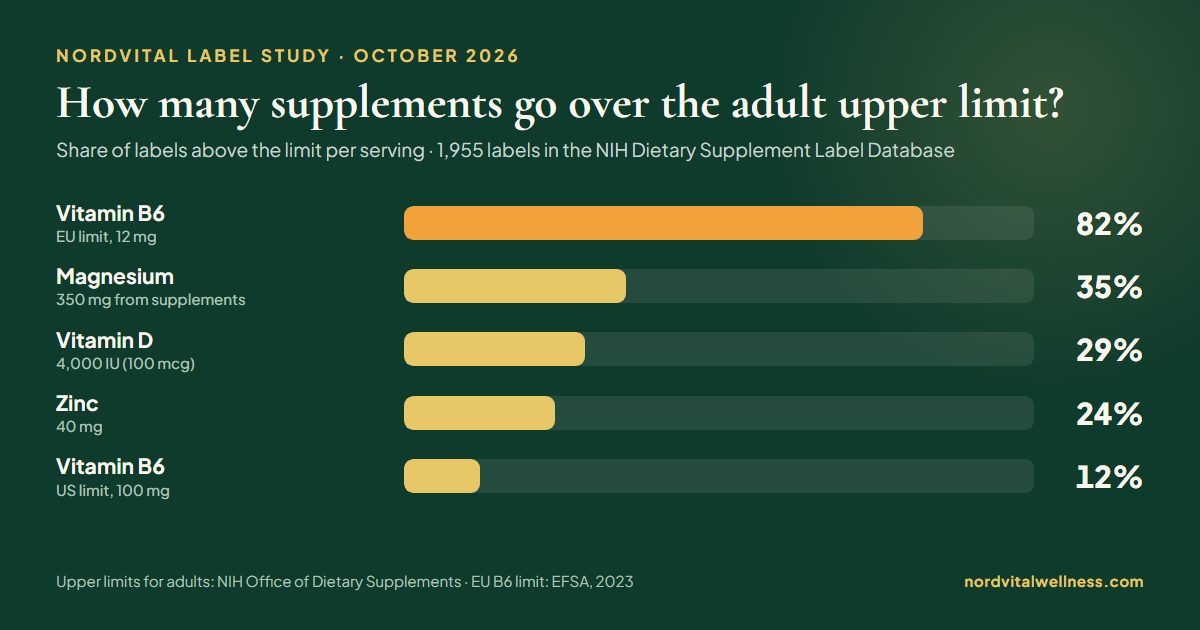
The results at a glance
| Nutrient | Labels checked | Most common dose | Adult upper limit | Over the limit per serving | Over the limit at the label’s highest daily dose |
|---|---|---|---|---|---|
| Magnesium | 412 | 400 mg | 350 mg (from supplements only) | 35% | 52% |
| Vitamin D | 541 | 1,000 IU (25 mcg) | 4,000 IU (100 mcg) | 29% | 30% |
| Zinc | 523 | 50 mg | 40 mg | 24% | 31% |
| Vitamin B6 | 108 | 100 mg | 100 mg (US) · 12 mg (EU) | 12% (US) · 82% (EU) | 16% (US) |
| Biotin | 371 | 5,000 mcg | None set (adequate intake: 30 mcg) | No limit to compare | No limit to compare |
Upper limits for adults from the NIH Office of Dietary Supplements, except the EU limit for vitamin B6 (European Food Safety Authority, 2023). “Highest daily dose” uses the largest number of servings per day that the label’s directions allow.
Get our free supplement cheat sheet.
One page: typical doses, timing and upper limits for ten well-studied supplements. No upsell.
🔒 No spam. Unsubscribe anytime. We send 1-2 emails/month max.
What the upper limit means
The tolerable upper intake level (UL) is the “maximum daily intake unlikely to cause adverse health effects”, in the words of the NIH Office of Dietary Supplements. It is a ceiling for everyday, long-term use, not a dose to aim for. For vitamin D and zinc the limit covers food and supplements together; for magnesium it counts only supplements and medicines.
Magnesium: half of products go over at the highest daily dose
Of 412 magnesium products, 35% list more than 350 mg of magnesium per serving, the upper limit for magnesium from supplements. When we used the most servings per day that each label allows, 52% went over. According to the NIH, high doses of magnesium from supplements can cause diarrhea, nausea and stomach cramps.
Before you compare, read the “Magnesium (as …)” line on the Supplement Facts panel. A front label that says “magnesium glycinate 500 mg” usually means the whole compound, which contains much less elemental magnesium. Our free tool explains which magnesium form fits your goal.
Vitamin D: 3 in 10 products contain 5,000 IU or more
Half of the 541 vitamin D products (50%) contain 1,000 IU or less per serving, not far from the adult RDA of 600 IU. But 29% contain 5,000 IU or more and 6% contain 10,000 IU or more, while the upper limit for adults is 4,000 IU a day from all sources. The NIH notes that too much vitamin D can cause high blood calcium (hypercalcemia), and in extreme cases kidney failure and heart rhythm problems. To find a dose that fits you, try our vitamin D dosage calculator.
Zinc: the most common dose is above the limit
The single most common zinc dose in our sample was 50 mg (107 of 523 products), above the 40 mg upper limit for adults. Overall, 24% of zinc products exceed 40 mg per serving, and 31% do at the label’s highest daily dose. The RDA is 11 mg for men and 8 mg for women. The NIH warns that 50 mg of zinc or more, taken for weeks, can interfere with copper absorption, reduce immune function and lower HDL (“good”) cholesterol. See our zinc guide for doses and forms.
Vitamin B6: the US and EU limits disagree
The most common B6 doses were 100 mg and 50 mg, about half of all products. That is roughly 30 to 60 times the highest adult RDA (1.7 mg a day). Only 12% exceed the US upper limit of 100 mg, but 82% exceed the 12 mg a day that the European Food Safety Authority set for all adults in 2023, after reviewing the link between vitamin B6 and peripheral neuropathy (nerve damage). The NIH notes that 1 to 6 grams a day taken for 12 to 40 months can cause severe, progressive nerve damage.
Biotin: no limit, but it can skew lab tests
There is no upper limit for biotin: according to the NIH, there is no evidence in humans that it is toxic at high intakes. The adequate intake for adults is 30 mcg a day. The most common doses in our sample were 5,000 mcg (132 products) and 10,000 mcg (107 products), and 69% of products contain 5,000 mcg or more, about 167 times the adequate intake. The FDA has warned that biotin above recommended intakes can cause falsely high or falsely low results in some lab tests, including thyroid tests and troponin, a test used to diagnose heart attacks. If you take biotin, tell your doctor before a blood test.
How to check your own supplement
- Find the Supplement Facts panel, not the front of the bottle.
- Multiply the amount per serving by the number of servings you take each day.
- Add any other product you take with the same nutrient, such as a multivitamin.
- Compare the total with the table above. If you are over the limit, ask your doctor or pharmacist whether that dose makes sense for you.
Our supplement dosage chart lists typical doses for 16 supplements, and the supplement timing chart shows when to take them.
How we did this study
- Source: the Dietary Supplement Label Database of the NIH Office of Dietary Supplements, through its public API (version 9), on 16 October 2026.
- Search: one search per nutrient (“vitamin d3”, “magnesium”, “zinc”, “vitamin b6”, “biotin”), reviewing up to the first 1,500 results of each.
- Which labels: labels marked as on the market whose product name includes the nutrient (for example “Vitamin D3 5000 IU” or “Magnesium Glycinate”). We removed duplicate entries of the same product (same brand, name and amount). Of 2,585 matching labels, 1,970 listed an amount we could read.
- Amounts: the amount per serving from the label’s ingredient list, and the maximum servings per day from its directions (one serving when the label does not say).
- Errors removed: we excluded 15 entries with obvious unit errors, such as a “Biotin 8 mg” product recorded as 8,000,000 mcg, using fixed caps: vitamin D above 50,000 IU, zinc above 150 mg, magnesium above 1,000 mg, vitamin B6 above 500 mg and biotin above 100,000 mcg. That leaves 1,955 labels.
- Limits: amounts are what labels state, not lab measurements. The database can contain entry errors and outdated “on the market” status. The search covers the first 1,500 results per nutrient, not every product sold, and it leaves out products that contain the nutrient without naming it, such as most multivitamins. We did not test any product.
- Data: download the dataset (CSV), with the NIH label ID, amount per serving and servings per day for every label, including the 15 we excluded and why.
Frequently asked questions
Is it dangerous to take more than the upper limit?
Not automatically. The upper limit is the most you can take every day, long term, without likely side effects. Going over it now and then is not the same as taking a high dose daily for months. If a doctor has told you to take a higher dose, follow their advice.
Does the upper limit include food?
For vitamin D and zinc, yes: the limit covers food, drinks and supplements together, although the NIH notes that food alone rarely provides that much zinc. For magnesium, the 350 mg limit applies only to supplements and medicines, because too much magnesium from food does not pose a health risk in healthy people. High intakes of vitamin B6 from food have not been reported to cause side effects either.
Which nutrient had the most products over the limit?
Using US limits, magnesium: 35% of products per serving and 52% at the highest daily dose on the label. Using Europe’s newer limit for vitamin B6, 82% of B6 products were over.
Sources
- NIH Office of Dietary Supplements, Dietary Supplement Label Database (API v9), accessed 16 October 2026.
- NIH Office of Dietary Supplements. Fact sheets for health professionals: vitamin D, magnesium, zinc, vitamin B6 and biotin.
- EFSA Panel on Nutrition, Novel Foods and Food Allergens. Scientific opinion on the tolerable upper intake level for vitamin B6. EFSA Journal 2023;21(5):8006.
This study is for education and is not medical advice. NordVital did not test any products.




Level up your recovery
Supplements work best alongside the right recovery tools. Explore our gear guides: