Affiliate links: as an Amazon Associate and through other programs, we earn from qualifying purchases, at no extra cost to you. Learn more.
Updated 2026
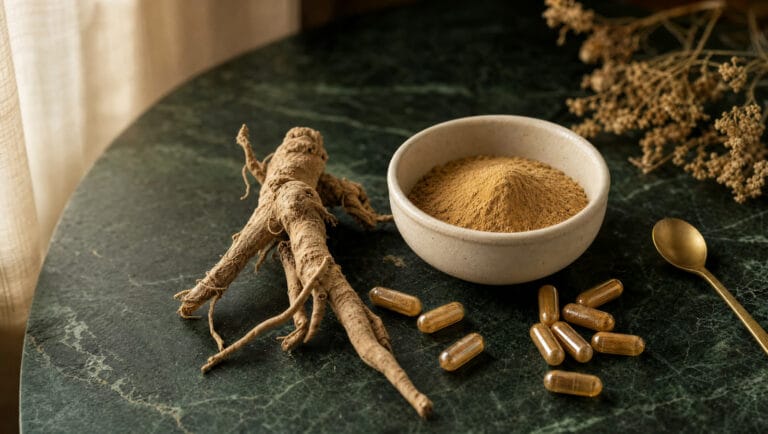
Ashwagandha doesn’t work like a stimulant: you won’t feel it within an hour. It is sold as an adaptogen: in trials, its effects built up over several weeks, and some trials found lower cortisol levels. Understanding this timeline prevents the common mistake of stopping too soon. Related: our evidence-based cortisol reduction guide.
In This Article
Ashwagandha Results Timeline: Week by Week

Weeks 1 to 2: Too Early to Judge
Trials did not measure effects this early. In a 2019 trial in people with insomnia, sleep onset improved in both groups, and the difference from placebo was significant after 10 weeks. A meta-analysis of 5 trials found larger sleep benefits at 600 mg a day or more and after at least 8 weeks.
Ashwagandha supplements compared: extract and dose (2026)
| Product | On the label | Good to know | Buy |
|---|---|---|---|
| Our pick Nutricost KSM-66 Ashwagandha | 600 mg KSM-66 root extract (min. 5% withanolides) + 5 mg BioPerine per capsule | The extract and the 600 mg daily dose used in several clinical trials. | See it on Amazon ↗ |
| NOW KSM-66 Ashwagandha | 600 mg KSM-66 root extract per capsule | The same extract and dose, without black pepper extract. | See it on Amazon ↗ |
| Life Extension Optimized Ashwagandha | 125 mg Sensoril extract per capsule | A different extract (root and leaf) that is dosed lower, usually 125 to 250 mg a day. | See it on Amazon ↗ |
| Organic India Ashwagandha | 800 mg organic ashwagandha per 2 capsules | No withanolide percentage on the label, so it is not a standardized extract. | See it on Amazon ↗ |
Not for use in pregnancy, and rare cases of liver injury have been reported (NCCIH).
Label figures: NIH Dietary Supplement Label Database and the brand listing, checked October 2026. Formulas change, so check the label before you buy. We earn a commission on Amazon purchases at no extra cost to you, and we do not lab-test products.
Weeks 4 to 10: Stress and Anxiety
Stress trials usually lasted 8 to 10 weeks. In a 60-day trial of 64 adults with chronic stress, 300 mg of root extract twice a day cut perceived stress scores by 44% (versus 5.5% on placebo) and blood cortisol by about 28% (versus 8%). NCCIH says some preparations may help with stress and insomnia, but the evidence for anxiety is unclear.
Get our free supplement cheat sheet.
One page: typical doses, timing and upper limits for ten well-studied supplements. No upsell.
🔒 No spam. Unsubscribe anytime. We send 1-2 emails/month max.
Week 8: Strength and Recovery
In an 8-week trial of 57 young men starting resistance training, 300 mg of root extract twice a day led to larger gains in strength and muscle size, and lower markers of muscle damage, than placebo. Trials did not measure energy or focus at earlier time points, and NCCIH says there is not enough evidence on athletic performance or cognitive function.
Weeks 8 to 12: Testosterone
Testosterone results come from small trials. In a crossover trial of overweight men aged 40 to 70, 8 weeks of an ashwagandha extract raised testosterone 14.7% more than placebo, with no difference in fatigue or vigor. NCCIH calls the evidence limited, and ashwagandha is not a treatment for low testosterone.
After 12 Weeks: Little Data
Most trials lasted 8 to 12 weeks, so there is little data on benefits after that. NCCIH notes that ashwagandha may be safe for up to 3 months and that its long-term safety is unknown.
How to Tell If It Is Working
The effects seen in trials were modest, so changes can be subtle. Keep a simple daily 1 to 10 log of stress, sleep and energy and compare week 1 with week 8. There is little research on what happens when you stop taking it.
Factors That Affect How Quickly Ashwagandha Works
- Baseline stress level: most trials enrolled adults with high stress, so the effects in people with little stress are less clear
- Dose: in a sleep meta-analysis, effects were larger at 600 mg a day or more
- Form: most trials used standardized extracts such as KSM-66; plain root powder is much less studied
- Consistency: trials used daily doses, so occasional use has not been tested
When to Give Up (It’s Not Working)
If you have taken a standardized extract at 300 to 600 mg a day for 8 weeks with no change in sleep, stress or energy, it is reasonable to stop. Most trials lasted 8 to 10 weeks, and NCCIH says its safety beyond 3 months is unknown.
The Bottom Line
Give ashwagandha at least 8 weeks before judging effectiveness. Use 300 to 600 mg a day of a standardized root extract such as KSM-66, the doses used in most trials, take it daily with food, and track your stress, sleep and energy with a simple 1 to 10 daily log. Safety first: NCCIH says to avoid it during pregnancy and breastfeeding and if you have a thyroid or autoimmune disorder, reports rare cases of liver injury, and warns that it may interact with diabetes, blood pressure, thyroid, anti-seizure and immune-suppressing medicines and with sedatives. Talk to your doctor before you start.
Individual Variation: Why Effects Vary
Not everyone responds to ashwagandha equally. Factors that influence response:
- Form and standardization: KSM-66 (a root extract standardized to at least 5% withanolides) and Sensoril (a root and leaf extract) are the most studied. Non-standardized root powder has highly variable withanolide content.
- Compliance: the benefits seen in trials came from daily use; occasional use has not been studied.
What Happens When You Stop Taking Ashwagandha
There is little research on what happens when you stop taking ashwagandha: most trials lasted 8 to 12 weeks and did not follow people afterwards. The NIH notes it may be safe for up to 3 months and that its long-term safety is unknown.
Combining With Other Adaptogens
Ashwagandha is one of the better-studied adaptogens. Several trials found a modest drop in cortisol; results for perceived stress are mixed and the testosterone evidence is limited (NIH). Choose an extract tested in trials (KSM-66, Sensoril or Shoden), use it for up to 3 months, and skip it if you have a thyroid or autoimmune condition, liver problems, or are pregnant.
Ashwagandha + rhodiola is a commonly used adaptogen stack:
- Ashwagandha: may help with stress and sleep after several weeks of daily use (NCCIH)
- Rhodiola: promoted for fatigue and stress, but NCCIH says there is not enough reliable evidence that it helps
No trial has tested the two together, so the combination is unproven. If you try both, start one at a time so you can tell how each affects you, and ask your doctor first if you take any medicine (rhodiola has been reported to interact with losartan).



- 1Chandrasekhar K, et al. (2012). A prospective, randomized double-blind, placebo-controlled study of safety and efficacy of a high-concentration full-spectrum extract of ashwagandha root in reducing stress and anxiety. Indian J Psychol Med. PMID 23439798
- 2Wankhede S, et al. (2015). Examining the effect of Withania somnifera supplementation on muscle strength and recovery. J Int Soc Sports Nutr. PMID 26609282
- 3Lopresti AL, et al. (2019). An investigation into the stress-relieving and pharmacological actions of an ashwagandha (Withania somnifera) extract. Medicine. PMID 31517876
- 4Ambiye VR, et al. (2013). Clinical evaluation of the spermatogenic activity of the root extract of ashwagandha in oligospermic males. Evid Based Complement Alternat Med. PMID 24371462
All studies are peer-reviewed and sourced from PubMed/NCBI. This article is for informational purposes only and does not constitute medical advice. Consult a qualified healthcare provider before starting any supplement regimen.